PHSP vs METC for Incorporated Professionals
A PHSP deducts from dollar one; the METC only kicks in above a threshold.

For an incorporated professional, health expenses aren't just a personal cost, they're a tax planning decision that touches both the corporate and personal returns. Two mechanisms handle this: the Private Health Services Plan (PHSP) and the Medical Expense Tax Credit (METC). They aren't competitors offering the same thing at different prices. They sit at different levels of the tax system entirely, and once you see how each one actually works, the decision about which to use follows directly from arithmetic rather than guesswork.
The setup that makes this decision necessary is structural. An incorporated professional is both the shareholder and the employee of their own corporation. Every benefit decision gets tested against two different sets of tax rules at once. Canada's public system pays for hospital stays and physician visits, but dental, vision, physiotherapy, mental health care outside a physician's office, massage, chiropractic, and most prescriptions (with some exceptions now under the 2024 Pharmacare Act and select provincial drug plans) fall outside that coverage. An employee with a group plan doesn't feel this gap. A solo incorporated professional does, dollar for dollar, unless the corporation is set up to absorb it.
How a PHSP works at the corporate level
A PHSP is defined in section 248(1) of the Income Tax Act as a contract of insurance for hospital or medical expenses, or a medical or hospital care insurance plan, that isn't already part of a provincial or federal government health plan. CRA's practical test for qualification is that all or substantially all of the premiums paid under the plan, interpreted as 90% or more, must go toward expenses eligible under the METC.
This isn't a new invention. CRA laid the groundwork back in 1986 with IT-85R2, covering Health and Welfare Trusts for Employees. That is where the structure now known as a health spending account originated. IT-339R2 followed in 1989 with PHSP guidance for non-incorporated businesses. So the framework has been sitting in the tax code for decades, even if most incorporated professionals never hear about it until an accountant brings it up.
The mechanics are straightforward once set up:
- The corporation sets an annual benefit limit per employee class (owner-employees might have a different limit than staff)
- The employee pays for an eligible medical expense out of pocket and submits the receipt to a plan administrator
- The administrator reimburses the employee and bills the corporation
- The corporation deducts the reimbursement as a business expense, with no CPP or EI owing on it
- The employee receives the money completely tax-free
Eligible expenses match the same list used for the METC, defined under section 118.2(2) of the Income Tax Act. That's over 100 categories: prescriptions, dental, vision, hearing aids, physiotherapy, chiropractic care, private insurance premiums, and out-of-country medical treatment among them. Cosmetic procedures without medical necessity, gym memberships, and general wellness products don't qualify.
The detail that matters most here: a PHSP lives at the corporate level. It's a business expense deduction, not a personal credit. That single distinction is the foundation for everything that follows.
Where the METC operates in the tax system
The METC is a non-refundable federal tax credit, claimed on lines 33099 and 33199 of a personal return. It reduces tax owed, but it can't create a refund by itself, and it only applies to the portion of expenses that clears a threshold.
That threshold is the lesser of 3% of net income or a fixed federal dollar amount, set at $2,890 for 2026. Run the numbers on a modest example: someone earning $55,000 in net income has a 3% floor of $1,650. If they spent $7,000 on eligible medical expenses that year, only $5,350 of it is even eligible for the credit, before the credit rate gets applied.
And the credit rate itself is modest. Federally, it is 14% for 2026, down from 15% following Bill C-4 (Royal Assent March 12, 2026, effective July 1, 2025), which dropped the lowest federal personal tax rate to 14.5% blended for 2025 and 14% going forward. Provinces add their own METC on top, typically another 5% to 11%. Ontario's provincial rate, for instance, is 5.05%.
There's flexibility in the timing: the claim period can be any 12-month window ending in the tax year, not strictly January to December. That opens the door to bunching, timing elective procedures and large expenses into a single 12-month stretch to clear the threshold in one shot rather than spreading them thin across two tax years.
Assigning the medical expense claim to the lower-income spouse lowers the 3% floor, which increases how much of the total expense becomes claimable. Assigning the medical expense claim to the lower-income spouse lowers the 3% floor, which increases how much of the total expense becomes claimable. Take a spouse earning $40,000 with $12,000 in family medical expenses: the floor is $1,200, leaving $10,800 claimable, a meaningfully better outcome than assigning it to a higher earner.
One rule closes off any temptation to double up: an expense reimbursed through a PHSP can't also be claimed under the METC.
The METC, in short, is a personal-return credit that only kicks in above a threshold, calculated at a rate tied to the lowest federal bracket. For a professional earning income well above that bracket, through the corporation, that's a mismatch.
The core tax advantage the PHSP has over the METC, and why it is structural not incidental
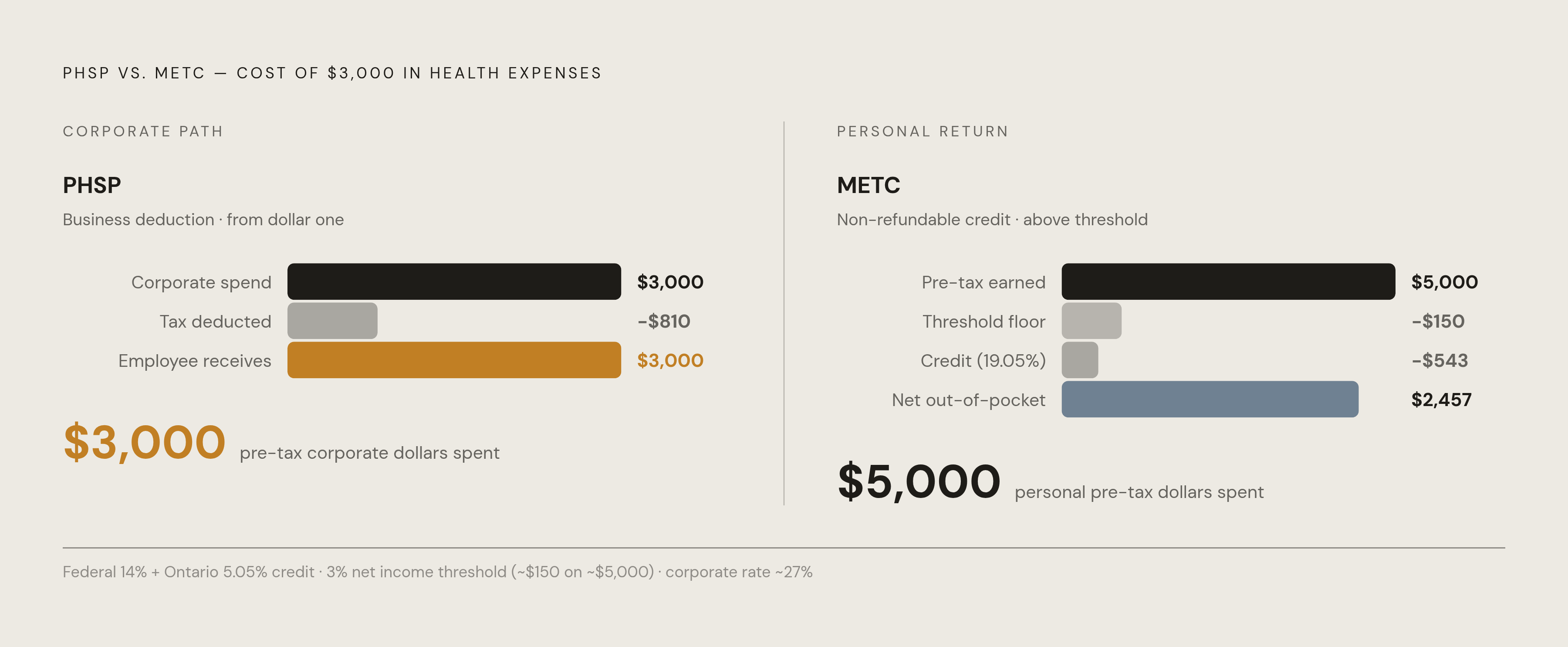
The gap is this: the METC only applies above the 3% threshold, and pays out at 14% federally plus a provincial top-up. The METC only applies above the 3% threshold, and pays out at 14% federally plus a provincial top-up. A PHSP deduction applies from the very first dollar spent, at the corporation's tax rate, and the employee receives the reimbursement completely tax-free. No floor to clear. No partial credit. Full deduction, from dollar one.
Put a number to it. A freelance professional who spent $4,200 in a year on dental work, prescriptions, and physiotherapy, with no plan in place, would have saved somewhere around $1,700 in tax had that same spending flowed through a corporate PHSP instead. That's not a number the METC can get close to at typical incorporated-professional income levels, because the METC's math caps out well before it reaches that kind of relief.
The reason comes down to the gross-up: paying $3,000 personally for dental and vision work means earning roughly $5,000 pre-tax to cover it, once personal income tax eats into the paycheck. Paying $3,000 personally for dental and vision work means earning roughly $5,000 pre-tax to cover it, once personal income tax eats into the paycheck. Routing that same $3,000 through a PHSP turns it into a corporate deduction, funded with corporate dollars taxed at the corporate rate rather than a personal marginal rate. Depending on the province and the individual's personal tax bracket, that swap tends to save somewhere between $500 and over $2,000 a year on typical family medical spending.
None of this makes the METC useless. It's the right tool when PHSP conditions can't be met, when most income comes from employment rather than the corporation, when expenses are modest enough to be near the 3% floor anyway, or when no formal plan has been set up. And even with a PHSP running, any expense the plan doesn't reimburse, because it falls outside the defined limit or the annual cap's already hit, can still go on the personal return under the METC. The two can overlap, though they still function in distinct ways. They're just not interchangeable either.
The shareholder-employee problem: why CRA compliance is harder for solo incorporated professionals than it looks
Things get complicated for the one-person professional corporation. CRA's default assumption, when a PHSP is set up for a corporation's sole shareholder-employee, is that the benefit flows from the shareholding relationship, not the employment relationship. And a shareholder benefit is taxable to the individual, not deductible to the corporation.
That position isn't speculation. CRA's May 2022 CALU Roundtable response (2022-0928901C6) states directly that a health spending account set up for a single shareholder-employee and their family "likely does not qualify as a PHSP," because the sole shareholder-employee is effectively just funneling personal medical costs through the corporation without any actual insurance risk changing hands.
Get this wrong, and the consequence hits from both directions at once. The reimbursement becomes a taxable benefit on the individual's side, and it's simultaneously non-deductible for the corporation. That's not a wash, it's double taxation dressed up as a benefit plan.
This is exactly the structure a solo physician, lawyer, or dentist runs. One person, one corporation, no arm's-length employees to point to as a comparator. That's the profile CRA's presumption is built to catch.
None of this means a solo PHSP is dead on arrival. The presumption is a question of fact, not an absolute rule, and it can be rebutted with the right documentation. CRA also expects a formal written plan with defined coverage limits. A plan with no cap, offering unlimited reimbursement, doesn't look like an employee benefit arrangement. It looks like a slush fund, and CRA will treat it that way.
How to rebut the shareholder-employee presumption and structure a qualifying PHSP
CRA's published guidance lays out the rebuttal standard: if the shareholder is genuinely engaged as an employee, and the benefits (including the limits set) are reasonable given all the circumstances, CRA's general position is that the benefit flows from employment, not shareholding, and qualifies as tax-exempt.
Meeting that standard takes real documentation. A few things matter most:
- Active employment: the shareholder has to be genuinely doing the work of the business, not holding a nominal title
That last point, the comparator requirement, is the hardest one for a solo professional to satisfy, simply because there's no obvious arm's-length employee sitting next to them to compare against. In practice, professionals lean on industry benchmarks instead. In practice, the benefit limit set should be reasonable relative to what a comparable arm's-length employee would receive. Setting the cap materially above what a reasonable comparator would support invites CRA to challenge the excess as a shareholder benefit rather than an employment one.
Professionals who employ others besides themselves have a much easier path here. If non-shareholder employees are covered under the same plan, with consistent benefit classes across the group, the arrangement starts to look like what it's supposed to be: an employer benefit plan, not a personal reimbursement account wearing a corporate label.
Administration matters too. CRA's position is that the arrangement has to function like insurance. A cost-plus plan run through a qualified third-party administrator holds up far better than a plan the shareholder administers alone. Third-party administrators typically charge somewhere in the range of 5% to 10% of each approved claim, though flat annual fee models exist as well. A pay-as-you-go fee structure, a percentage-based fee on approved claims with no setup fee and no annual charge, avoids paying for administration in a year with few or no claims, which matters for a professional whose health spending varies year to year.
When the METC is the right answer versus a second-best fallback
A PHSP makes sense as the primary tool when several things line up at once: the corporation can meet CRA's employment conditions, annual health spending is substantial enough that a full deduction meaningfully beats a partial credit, the corporation has other employees to serve as a natural comparator, and the shareholder's personal marginal rate is high enough that routing expenses through the corporation actually moves the needle.
The METC becomes the primary route instead when the rebuttal conditions can't be met, when the professional's income comes mostly from employment rather than the corporation, when annual expenses are near or below the 3% threshold anyway, or when no formal plan exists yet and setting one up isn't practical right now.
Even with a PHSP running, the METC doesn't disappear. Whatever the plan doesn't cover, because it exceeds the annual limit or falls outside the defined categories, stays claimable on the personal return. Only the reimbursed portion is off-limits.
For those relying on the METC as the primary or supporting tool, the same bunching and spousal-assignment strategies apply: timing elective expenses into a single 12-month claim window, and assigning the family's claim to whichever spouse has the lower income, to shrink the 3% floor as much as possible.
Sole proprietors and unincorporated professionals don't have access to the corporate PHSP route. They may be able to deduct premiums as a business expense if self-employment income makes up at least 50% of total income and other income stays under $10,000. Outside of that narrow case, the METC is the only option on the table.
Where the corporate structure and CRA's compliance conditions are met, a PHSP turns after-tax personal health spending into a pre-tax corporate deduction, no threshold, full coverage, tax-free to the employee. Where those conditions can't be met, the METC still delivers partial relief, and it should be claimed regardless, especially in a high-expense year.
Practical steps for an incorporated professional moving from the METC to a PHSP
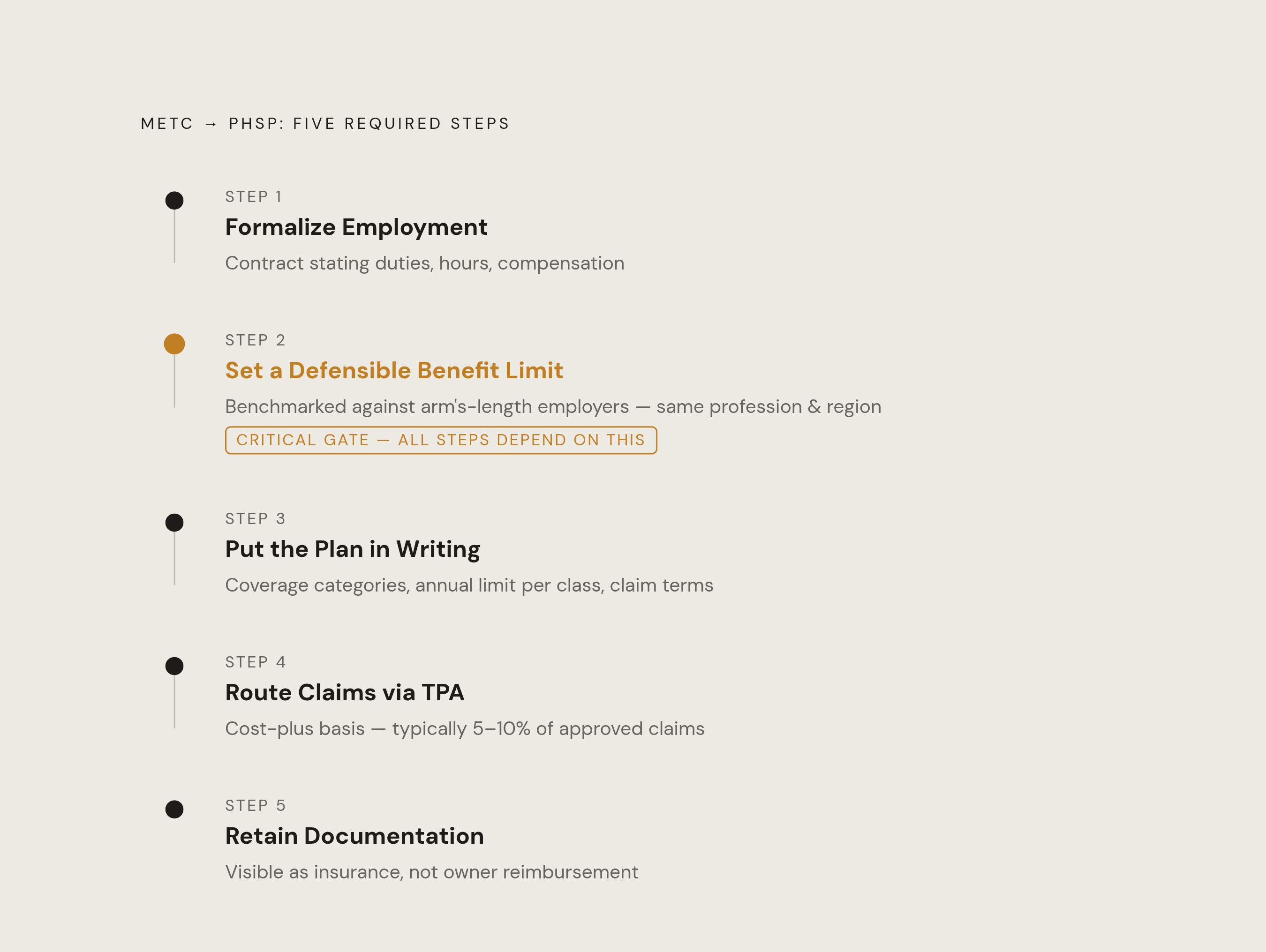
Moving from relying on the METC to running a compliant PHSP isn't a single decision, it's a sequence of documentation steps, each one closing off a specific angle CRA might challenge.
Step 1: Formalize the employment relationship. Draft or update an employment contract between the corporation and the shareholder-employee. It should spell out actual duties, hours worked, and compensation, because this is the paper trail that supports the claim that the shareholder is genuinely an employee, not just a titleholder collecting benefits.
Step 2: Set a defensible benefit limit. Look at what arm's-length employers in the same profession and region actually offer comparable employees. Industry benchmarks and comparator employee data serve as the practical reference for setting a reasonable limit. Whatever the number, it needs an external reference point, established because arm's-length employers actually pay that amount, not a figure picked because it matched last year's dental bill.
Step 3: Put the plan in writing, with defined coverage categories, a stated annual limit per employee class, and clear terms for how claims get submitted and reimbursed. A plan that exists only as a verbal arrangement between the shareholder and their bookkeeper won't hold up if CRA asks for the documentation.
From there, routing claims through a third-party administrator on a cost-plus basis, rather than self-administering, closes the last major gap CRA looks for: whether the arrangement actually functions as insurance, or just as a corporation reimbursing its owner's personal expenses with a different name on the transaction.
Sources
- Best Health Insurance for Self-Employed Canada 2026: HSA vs Plans | SmartSMSSolutions
- Canada METC 2026: Claim Private Surgery Expenses
- Is Health Insurance Tax Deductible in Canada? | PolicyMe
- canadianmoneyhelp.ca
- healthquotes.ca
- catax.tools
- PHSP Alberta — Health Spending Account for the Self-Employed | Frank Cover
- purposecpa.ca