Board Resolution and Plan Adoption Documentation for PHSPs
Written documentation must precede any claim to keep employee health benefits tax-free.

A Private Health Services Plan does not exist, legally speaking, until it is written down. That is the whole starting point for this article. Under CRA rules, a PHSP has to be set out in writing before a single claim gets processed. Skip that step and a medical reimbursement is not a PHSP payment; it is just a taxable benefit to the employee, with narrow exceptions such as a mandatory pre-employment medical exam. CRA guidance turns on one phrase: a reimbursement has to be paid "under the terms of a private health services plan." Those terms have to exist in writing before the money moves. That single requirement decides which tax regime applies to the whole arrangement. A reimbursement made under documented terms is tax-free to the employee and deductible for the business. The same reimbursement, made without those terms in place, is simply taxable income. Nothing about the medical expense itself changes between those two outcomes. Only the paperwork does.
CRA also requires the plan to function as, in its words, "a plan in the nature of insurance." That phrase carries five specific elements: an undertaking by one person, to indemnify another, for an agreed payment, against a loss or liability, where the chance of that loss happening is genuinely uncertain. A health spending account set up for a small corporation has to meet all five of these to count as a PHSP. If an arrangement misses one of these elements, it becomes something else wearing a PHSP's name. None of this is bureaucratic decoration. It is the mechanism that makes the tax treatment real.
The three ITA provisions that define what the documentation must achieve
Every piece of paper tied to a PHSP, from the plan terms to the board minutes, exists to satisfy three specific parts of the Income Tax Act. Knowing these three sections tells a business owner what the documentation has to prove, rather than leaving it as a vague compliance gesture.
The three provisions work together. Section 248(1) supplies the definition: what counts as a PHSP. Section 18(1)(a) allows the business to deduct what it pays into the plan. Section 6(1)(a)(i) keeps what the employee receives out of their taxable income. Those three sections form a chain: define the plan correctly, and the deduction and the tax-free benefit follow.
One more rule sits underneath all three. "Substantially all" means almost the entire amount, leaving only a small margin for ineligible expenses. The plan document has to define covered expenses tightly enough to clear that bar. A plan that drifts into covering a meaningful share of non-eligible expenses doesn't bend its PHSP status. It loses it.
What the written plan document must contain
The written plan document is the piece of paper that makes a PHSP exist. Leaving out one of its core elements means the document stops functioning as a plan, no matter how good the intentions behind it were. A few things belong in every plan document, without exception.
The benefit amount for each employee, or each class of employee, needs to be set before the plan year opens and held fixed through that year. The plan year itself needs a clear start and end date, whether it tracks the calendar year or the corporation's fiscal year. Eligible expense categories need a precise definition, one that keeps the plan inside the list of eligible medical expense categories and comfortably past the "substantially all" threshold. The document needs restrictions and exclusions: a fixed annual limit that can't move mid-year, along with a rule tying every claim to an expense actually incurred, gives the plan its insurance character. Employee classes need a documented, defensible basis: different groups can get different limits, but only if the structure behind that difference is written down. And a carry-forward rule needs a hard ceiling: unused credits can roll forward for no more than twelve months. Allow unlimited carry-forward and the plan stops carrying any real risk of non-use, which is the thing that made it insurance to begin with.
A plan document with no limits on coverage at all is unlikely to pass as a PHSP. The limits are not a constraint bolted onto the idea of insurance. They are what makes it insurance. From here, the plan needs a method of administration, either through a third-party administrator or through an internal written policy paired with the employment contract. A third-party administrator, when used, holds premiums in trust, reviews and adjudicates claims, and produces accounting records. That is one valid path, not the only one, but whichever path gets chosen needs to be in writing.
The board resolution as the corporation's formal act of adoption
The board resolution is the formal act by which the corporation, not the owner personally, adopts the PHSP, turning it from a private understanding into a corporate one. That distinction matters both for how the law treats the plan and for how a CRA auditor reads the file. The resolution is the clearest piece of evidence that the benefit flows from employment, not from share ownership.
A corporate resolution has four parts: a heading naming the legal entity and the board, recitals describing the matter at hand, the body setting out what's being authorized, and attestation from the corporate secretary or another authorized officer confirming it's accurate. These resolutions live in the minute book as a routine part of corporate governance, and a PHSP resolution is no different.
The resolution has to do five things: name the plan formally as a distinct corporate undertaking, fix the plan year and its effective date, define which employee classes are covered and what each class's annual limit is, authorize how the plan will be administered (including any third-party administrator), and carry the directors' attestation confirming the board actually approved it.
One timing detail carries more weight than almost anything else in this whole process: the effective date on the resolution has to come before the first claim is submitted, never on the same day and certainly never after. A resolution signed after the first reimbursement has already gone out doesn't just create a paperwork gap. It retroactively disqualifies that reimbursement, turning it into a taxable benefit after the fact. This is one of the most common and most expensive mistakes in PHSP administration, and it is entirely avoidable with the right sequencing. The signed resolution belongs in the corporate minute book, where its presence signals that the plan is a governed corporate program rather than something improvised on an as-needed basis.
What the shareholder-employee distinction turns on
CRA starts from a presumption that cuts directly against small incorporated businesses. If a shareholder can significantly influence business policy, CRA presumes any benefit they receive comes from their ownership stake, not their work as an employee. The plan document and the board resolution are the two pieces of evidence that push back against that presumption.
For a shareholder-employee's PHSP benefit to hold up, it has to flow from the employment relationship. The shareholder needs to be actively working in the business, and the benefit itself needs to look reasonable next to what an arm's-length employee doing similar work would receive. A sole employee-shareholder faces the sharpest version of this problem. CRA's 2014 Technical Interpretation 2014-0521301E5 states that a cost-plus arrangement for a sole employee-shareholder does not qualify as a PHSP, because it lacks the necessary elements of insurance, and that such an arrangement would not likely count as a plan in the nature of insurance. For a business with exactly one owner-employee, the plan document has to work harder to establish real insurance character, since there's no comparison group of other employees to point to.
Where a business has multiple employees, the documentation needs to show consistent limits across similar employee classes. If the owner's limit sits far above what arm's-length employees in a comparable role receive, that gap invites CRA to conclude the benefit tracks ownership. Taken together, the resolution and the plan document form the paper trail an auditor will pull apart: the resolution shows the benefit was adopted as a corporate employment program, and the plan document shows its terms match what an arm's-length employment arrangement would look like.
Keeping the plan's insurance character intact through what the documents do not permit
Some drafting choices feel like harmless administrative convenience and end up stripping a plan of its insurance character entirely, turning it into something CRA will read as disguised salary. Knowing what to leave out of a plan document matters as much as knowing what to put in.
Annual limits need to be locked in before the plan year starts, and they can't be bumped up mid-year to match claims as they come in. That's a minimum standard, not a suggestion: a plan that lets limits move retroactively erases the uncertainty of loss that insurance depends on. The plan document also shouldn't hand the employer unlimited termination rights with no notice required, because ending coverage at will, without notice, signals that no real risk was ever transferred. That absence of transferred risk is what disqualifies a plan from being insurance. Carry-forward needs its twelve-month ceiling, since letting credits roll forward without limit guarantees the employee eventually recovers every dollar, and a guarantee like that isn't insurance by definition.
Self-insured plans built around a single owner draw extra scrutiny. CRA's view is that a self-insured PHSP should cover all employees, or all employees in a defined category, under one plan with matching coverage within that category. A plan document that covers only the owner while formally carving out every other employee runs directly against that expectation. Reviewing a draft plan document against this list before signing, and before the plan year opens, catches most of these problems while they're still cheap to fix.
The adoption record: what to keep after the resolution is signed
Signing the resolution and the plan document starts the record-keeping obligation. It doesn't end it. What gets kept afterward is what lets the plan survive a CRA audit years down the line.
CRA auditors ask to see how the plan actually operates: who is entitled to what, and how claims get adjudicated. A third-party administrator, where one is used, has to issue proper accounting records, and those records need to be kept on file. The ongoing record set should include the original signed resolution and plan document in the minute book, any administrator agreements and their amendments, annual claim summaries showing what was paid to each employee class against the documented limits, individual claim records tying each reimbursement to a dated receipt for an eligible expense incurred during that plan year, and evidence that claims went through third-party adjudication. Internal adjudication without outside oversight is something CRA specifically flags as a compliance risk.
Retroactive documentation does not fix a gap that already exists. Missing documentation can nullify claims paid under an undocumented plan, and the exposure doesn't stop at the year under audit. Where CRA can establish misrepresentation, neglect, or carelessness, it can reassess years beyond the normal reassessment window, and it can do so across multiple years at once. The records kept after adoption are the proof that the plan described in the resolution and the plan document actually operated the way it was written. That continuity between what was written and what actually happened is the exact thing a CRA audit sets out to test.
How a third-party administrator fits into the documentation structure
Bringing in a third-party administrator is a structural piece of what makes the plan's insurance character hold up, because it cuts down the self-dealing risk that CRA treats as a sign a plan isn't genuine insurance. An administrator under contract holds premiums in trust, reviews and adjudicates claims, and produces accounting records, and each of those three jobs corresponds to something the plan would otherwise have to document and prove on its own.
Letting employees or the owner handle claims internally, without outside oversight, creates exactly the kind of compliance risk CRA looks for. CRA favors claims that move through adjudication channels built around established PHSP rules, and internal review alone chips away at the arm's-length character the plan document is trying to establish. A good administrator offers digital claim submission and tracking, adjudication measured against an established list of eligible medical expense categories, electronic reimbursement, and annual reporting that produces exactly the records an audit would ask for. Those features aren't nice extras. They feed directly into the record-keeping obligations that come up again the moment a plan faces review.
Setting up the documentation before the plan year opens
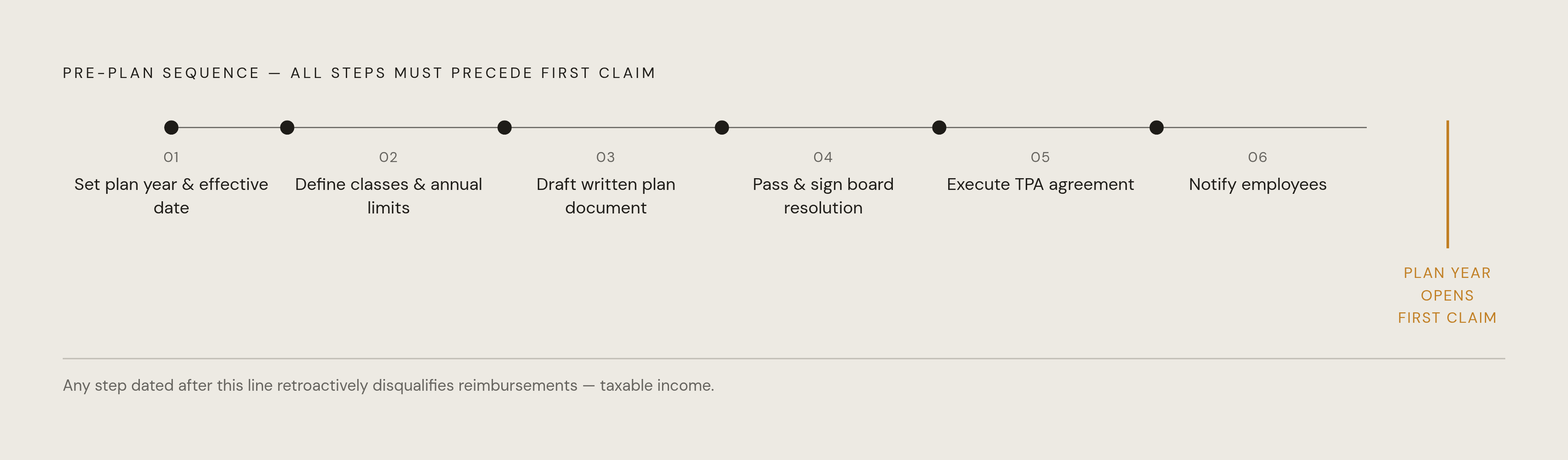
Backdating is the single most common mistake in PHSP compliance. Every piece of the documentation sequence has to be finished before the plan year starts and before the first claim goes in, because CRA does not recognize retroactive adoption under any circumstance.
The sequence starts with picking the plan year, whether calendar year or the corporation's fiscal year, and setting the effective date ahead of time. Next comes defining employee classes and fixing the annual limit for each class before the plan year opens, since that limit holds steady for the entire year once set. The written plan document comes next, covering benefit amounts by class, the plan year dates, eligible expense categories, restrictions, and the carry-forward rule. After the plan document is drafted, the board resolution needs to be passed, signed, dated before the effective date, and filed in the corporate minute book. Then comes the third-party administrator agreement, confirming that claim adjudication, trust holding, and record-keeping will run through an outside party. Employees need to be notified of what they're entitled to under the plan, and that notification itself becomes a record showing the benefit was offered as part of employment, not arranged privately for one person. Finally, every document in the chain, the plan document, the resolution, the administrator agreement, the claim records, and the annual summaries, needs to be kept on file for the full length of CRA's assessment window.
Done in that order, before the plan year opens, this sequence is what gives a PHSP its legal footing from day one.
Sources
- Accountant's Guide to PHSPs
- 4 February 2004 External T.I. 2003-0031971E5 - Qualification of a plan as a PHSP
- Medical expenses, including payments from a private health services plan (PHSP) - Canada.ca
- 22 November 2001 External T.I. 2001-0101935 - PHSP-COST PLUS PLANS
- Private Health Services Plan Right for My Professional Corporation?
- 26 May 1995 External T.I. 9501715 - SELF-FUNDED PRIVATE HEALTH SERVICES PLANS