CRA Receipt Standards for PHSP Medical Expense Claims
Receipts must show five key fields or CRA denies the deduction.

A private health services plan reimbursement is tax-free to the employee and deductible to the employer because CRA treats it as a qualifying health benefit. That treatment depends on one thing: the paperwork sitting behind each claim. If someone has a PHSP and wants their claims to hold up under a CRA review, the receipt is the whole case.
PHSP tax treatment and the receipt requirement
No receipt, no tax-free status, the entire relationship in one line.
A plan counts as a PHSP under CRA's rules, under IT-339R2 and the related guidance that followed it, when all or substantially all of the premiums paid go toward medical expenses that qualify for the Medical Expense Tax Credit. This structural test turns receipt quality into a compliance question. A sloppy receipt isn't just untidy, it's a weak point in the legal basis for the whole arrangement.
When a reimbursement can't be matched to a compliant receipt for an eligible expense, CRA has grounds to treat that payment as taxable employment income instead. That reclassification wipes out the reason the plan exists in the first place: no tax savings for the employee, no deduction for the employer, and a payment that now needs to be reported like a salary top-up. Every rule that follows in this piece exists to prevent that outcome.
The five fields CRA requires on every PHSP receipt
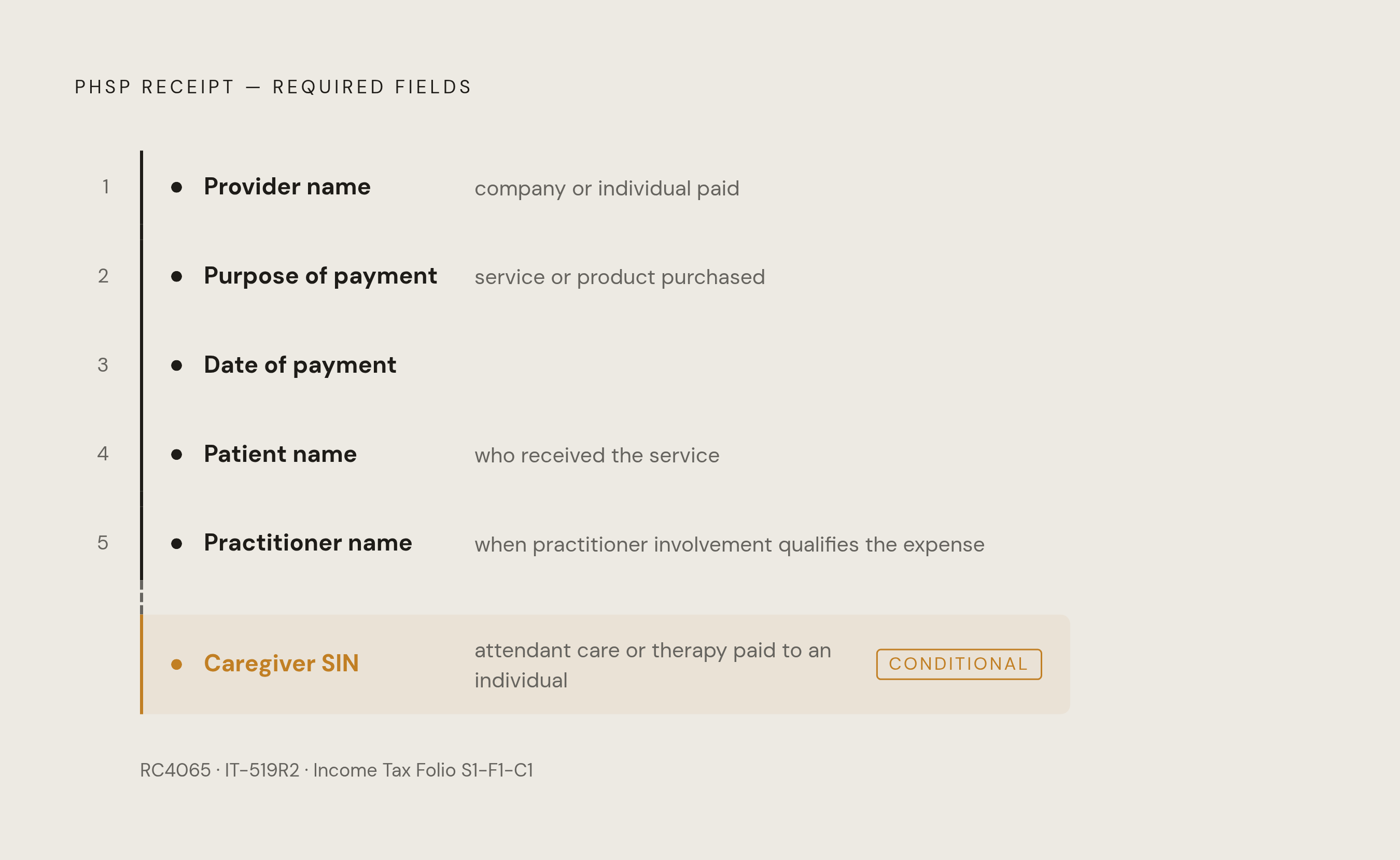
CRA's RC4065 guide on medical expenses lays out what a supporting receipt needs to show, and while CRA doesn't number these as a formal five-point checklist, five pieces of information make up the standard a receipt has to meet. A receipt missing any one of them isn't a compliant receipt for PHSP purposes, no matter how legitimate the underlying expense was.
The receipt needs to name the company or individual who was paid, the provider of the service or product. It needs to state the purpose of the payment, meaning what was actually bought or what service was performed. It needs a date of payment. It needs the name of the patient, the person the service or product was for, which may or may not be the person who paid. And where a medical practitioner's involvement is required for the expense to qualify, the receipt needs to name that practitioner.
There's a sixth field that applies in a narrower set of cases: attendant care or therapy paid directly to an individual also needs that individual's social insurance number on the receipt. This matters because CRA treats payments to an individual caregiver differently from payments to a clinic or corporation, and that identifying number is how that distinction gets documented.
None of this is a new invention. The standard traces back to IT-519R2, CRA's longstanding foundational bulletin on medical expenses, now cancelled and folded into Income Tax Folio S1-F1-C1. Current publications like RC4065 build on that same base. A receipt that shows the cost and the date but skips the patient's name, or names the provider but never describes the service, fails the test even when the expense itself is completely legitimate.
What does not count as a receipt
Some forms of payment evidence get ruled out entirely, even when they prove beyond doubt that money changed hands.
A cancelled cheque is not an acceptable substitute for a proper receipt. CRA's guidance is direct about this: proof that a payment cleared the bank isn't the same as proof of what the payment was for.
A till receipt or cashier slip from a pharmacy or retailer usually doesn't qualify either, because it typically skips the service description and the patient's name, two of the fields the standard requires.
The logic underneath both exclusions is the same. CRA checks whether the documentation shows what was bought, who it was for, and whether a practitioner was involved in recommending it. A cancelled cheque or a till slip can confirm the first question and still say nothing about the second.
When a compliant receipt is necessary but not sufficient
A compliant receipt gets a claim to the starting line, not across the finish line. For a wide range of PHSP-eligible expenses, CRA also requires a prescription, a written certification from a medical practitioner, or a specific form before the expense can be approved.
CRA's list of common medical expenses spells out, item by item, whether each one needs a prescription, a written certification, or Form T2201 (the Disability Tax Credit Certificate). Items that typically need a prescription include CPAP machines and other assisted breathing devices, air conditioners, hospital beds, orthopaedic shoes and inserts, insulin injection pens, laboratory procedures, electronic bone healing devices, and prescription eyeglasses or contact lenses. Other services, like note-taking support for someone with a disability, call for a written certification from a practitioner confirming the need. And some of the larger expense categories, including specified attendant care and facility costs, require Form T2201 on file, or in some cases a written certification from a qualified practitioner.
CRA's guidance also notes that which professionals are recognized to write these prescriptions or certifications can vary by province or territory. That's a jurisdictional wrinkle: confirm which practitioners are recognized in the relevant province or territory before assuming any signature will do.
Before submitting anything, confirm the expense actually appears on CRA's recognized list, figure out whether it needs a prescription or certification, and have that document ready alongside the receipt. Skipping that check is how an otherwise eligible expense gets denied over missing paperwork.
Common expenses that look eligible but regularly fail on documentation
Certain categories of expense recur on lists of rejected PHSP claims, usually not because the expense is clearly off-limits. The failure is almost always about missing or misunderstood documentation.
Over-the-counter vitamins and supplements are a good example. CRA's guidance states that over-the-counter medications don't qualify even with a doctor's recommendation, and the same goes for most vitamins and supplements. The one narrow exception is vitamin B12 therapy for pernicious anaemia, and even that requires a prescription. One documented case involved a company that submitted receipts for vitamins and supplements bought without prescriptions, and those claims were disallowed outright, confirming that OTC products without a prescription behind them fall outside what's eligible.
Gym memberships and general fitness expenses are excluded by name on CRA's list. Athletic or fitness club fees don't qualify no matter how complete the receipt is.
Cosmetic procedures, such as liposuction, hair replacement, wrinkle filler injections, or teeth whitening, don't qualify when performed purely for appearance. A procedure needed for medical or reconstructive reasons can qualify, but it needs documentation establishing that medical basis, not just a receipt for the procedure itself.
Prescription drugs can also trip up a claim if the receipt doesn't come with the pharmacist's dispensing record showing the drug name and the patient. Even a genuinely eligible drug fails the standard if that record is missing.
Home renovations for accessibility fall into a similar trap. They can be eligible, but they need a detailed invoice describing the actual work, along with documentation of the person's disability. A contractor's receipt with a single lump-sum number, and nothing describing what was done, isn't going to satisfy a review.
Digital receipts CRA accepts and storage rules
CRA treats digital receipts as equal to paper originals, so there's no need to hold onto physical copies of everything. That equivalence comes with conditions, set out under Information Circular IC05-1R1 on electronic record keeping, and those conditions matter as much as the receipt content itself.
Scanned paper receipts, email receipts, PDF invoices, and online purchase confirmations are all valid formats, provided they're legible, complete with all five required fields, stored in a format that's accessible, and ready to produce if CRA asks for them.
One condition is easy to miss: the digital record can't be altered after the fact. Even editing an image to make it more readable introduces risk, because CRA's standard depends on the record being an unaltered copy of what was originally issued.
Storage location is the part of this rule that catches most small businesses off guard. Records are supposed to be kept in Canada. If a business stores its documents on cloud servers located outside the country, that requires written permission from CRA, obtained by writing to the taxpayer's tax services office. Most businesses using offshore cloud platforms for their files have no idea this requirement exists until it becomes relevant.
None of this means paper has to be kept once a digital copy exists. But the digital copy has to actually capture every required field, at a resolution and completeness that would hold up if CRA asked to see it. A blurry phone photo that cuts off half the receipt doesn't meet that bar just because it's digital.
The arm's-length requirement for self-administered plans
Perfect receipts don't fix a plan that's structured the wrong way. CRA has a separate requirement sitting above the paperwork: the plan itself has to operate at arm's length, built to function like an insurance arrangement rather than a direct channel for funding personal expenses.
This is where self-administration becomes a real risk. When an incorporated professional or a small business reviews, approves, and reimburses its own claims internally, with no outside party involved, CRA can treat the whole arrangement as the employer directly funding personal health costs. That conclusion can hold even when every receipt attached to every claim is flawless.
What CRA looks for instead is a proper adjudication channel: claims processed by a party that is neither the plan member nor the plan member's employer, following established PHSP rules. That's the structural signal that separates an insurance-like plan from a reimbursement scheme dressed up as one.
In practice, this is why third-party administrators exist in this space. They process claims, check receipts against the documentation standard, and keep the arm's-length structure intact. That service typically costs a small administration fee, often described as running somewhere around five to ten percent of each approved claim. That cost is what buys the structural separation CRA is actually checking for, and it's the piece no amount of receipt quality can substitute for.
Record retention and CRA review of claims
Every receipt, prescription, certification, and piece of supporting documentation tied to a PHSP claim needs to be kept for at least six years. None of this gets submitted along with a tax return. It gets held, in case CRA asks to see it later.
CRA's guidance for the 2026 tax year confirms that six-year window and confirms that originals, or compliant digital copies, need to stay available for audit purposes.
Timing matters too. For PHSP administrators, expense receipts can't be dated beyond a certain window before submission, and they need to be payable in the year the claim was actually incurred. A receipt that falls outside that window can get rejected purely on timing, even if every field on it is filled in correctly.
CRA's own review process starts automated. Systems can flag and disallow claims that look incomplete or inconsistent before a person ever looks at the full context. A clean, organized audit trail resolves that kind of flag quickly. Tax Court decisions back this up: in CFI Funding Trust v. The Queen (2022 TCC 60), the court declined to deny credits over minor invoice discrepancies, because the underlying transaction was legitimate and the claimant had kept reasonable records in good faith.
The documentation standard exists to make an audit a non-event, resolved in a single exchange. Good records are a habit built claim by claim, not an emergency measure pulled together after CRA sends a letter. Every reimbursement a PHSP pays out is only as tax-free as the receipt sitting behind it, the standard to build toward from the very first claim.
Sources
- Medical Expenses 2025 - Canada.ca
- Lines 33099 and 33199
- ARCHIVED - Meaning of private health services plan [1988 and subsequent taxation years] - Canada.ca
- Medical expenses, including payments from a private health services plan (PHSP) - Canada.ca
- Income Tax Folio S1-F1-C1, Medical Expense Tax Credit - Canada.ca
- Understanding Business Receipts: What is Sufficient Documentation? - SAV Associates
- Deducting Premiums Paid for a Private Health Insurance Plan
- How to Deduct Your Medical Expenses on Tax Return?