Cosmetic and Elective Procedure Expense Classification
The tax code splits cosmetic procedures on medical purpose, not appearance alone.

The Canadian tax system does not shut the door on every elective or appearance-related procedure. It shuts the door on one narrow category: procedures performed purely for cosmetic purposes. That distinction lives in subsection 118.2(2.1) of the Income Tax Act, which pulls cosmetic medical and dental services out of the otherwise long list of expenses eligible for the Medical Expense Tax Credit, unless those same services turn out to be necessary for medical or reconstructive reasons. The same split runs through the Excise Tax Act on the sales-tax side: a service that maintains health, prevents disease, treats or relieves an injury, illness, disorder or disability, helps someone cope with a condition, or provides palliative care is exempt from GST/HST, while a cosmetic service gets taxed at the full rate. One classification call, once made, affects both the income tax credit and the sales tax charged on the invoice.
The money at stake is not symbolic. The METC is non-refundable, so it only reduces tax owed; it can't generate a refund. That makes a wrong call costly in both directions. Missing an eligible expense costs the taxpayer real value against the 2025 federal claim threshold of $2,834, as Canada.ca sets it. Claim a cosmetic expense that doesn't belong and the taxpayer risks an audit and a reassessment later. Everything that follows in this piece, every procedure, every document, every gray area, comes back to one word in the statute: purely. A procedure with any genuine medical rationale behind it survives the exclusion. Only a procedure with no medical purpose at all gets caught by it.
How the CRA applies the purpose test in practice
Whether a given procedure counts as purely cosmetic is a question of fact, decided case by case, and the burden of proving it isn't falls on the person making the claim. The CRA doesn't publish a master list sorting every procedure into approved or denied. Instead, it looks at the full record behind each claim: the diagnosis, the practitioner's notes, the billing, and anything else that speaks to why the procedure happened.
That puts the practitioner's paperwork at the center of the whole process. Because the claimant carries the legal onus, the clinical write-up becomes the proof. A detailed written description from the authorized medical practitioner, explaining the nature and purpose of the service, is the tool the CRA points to when someone needs to show that the cosmetic exclusion doesn't apply to their case. There's a useful shortcut here too: CRA guidance on GST/HST confirms that eligible medical services generally don't carry that tax. So if a provider charged HST on a procedure, that's a strong sign the provider already classified it as cosmetic, and the odds of it qualifying for the METC drop sharply.
This isn't a paperwork formality tucked into a footnote. It decides real outcomes on real tax bills. The burden sits oddly, too: the patient carries the legal responsibility, the practitioner holds the clinical evidence, and the CRA judges the whole thing after the fact. A patient whose practitioner never writes down the medical purpose at the time of treatment can lose a legitimate claim later, even when the medical reason was real all along. That gap between what happened clinically and what got written down matters most in the cases where a procedure could plausibly sit on either side of the line. The next sections head there.
Procedures that are always excluded
Some procedures never clear the purpose test, because nothing in the clinical picture separates them from plain aesthetic choice. The CRA's own guidance names several outright: rhinoplasty done purely to reshape the nose with no corrective goal, teeth whitening, liposuction done for body contouring, and botulinum toxin injections used for cosmetic purposes, including treatment of frown lines between the eyebrows. On the dental side, CRA guidance confirms that cosmetic veneers and whitening procedures fail to qualify, because they serve appearance rather than a medical need.
These same procedures land on the taxable side of GST/HST as well, so the income tax system and the sales tax system agree on where they sit. There's no clever workaround through incorporation either. If a personal corporation pays for a cosmetic procedure, the CRA treats it as a taxable shareholder benefit, and the individual still owes personal income tax on the full cost. An incorporated doctor or dentist can't turn a personal cosmetic expense into a business deduction by routing it through a company. This end of the spectrum is settled and well documented, which makes it a useful baseline before turning to the much larger set of procedures that can go either way depending on the medical facts behind them.
Procedures that qualify when the underlying condition drives the decision
A long list of procedures that look cosmetic at first glance become eligible medical expenses once a real diagnosis and a documented medical purpose support them. Breast implants and related procedures qualify when performed for reconstruction after a mastectomy, and breast reduction qualifies when the goal is relief from documented back and shoulder pain rather than a change in appearance for its own sake. Dental braces qualify when they correct a misaligned bite, since the functional correction is what makes the claim work; braces fitted purely for a straighter smile don't meet the same bar. Veneers follow the identical logic: they qualify when used to fix decayed or misaligned teeth, not when the goal is simply a better-looking smile.
Removal of excess skin after rapid weight loss qualifies when the medical justification is the risk of infection in the folds left behind, not the aesthetic improvement. Gastric bypass surgery qualifies, and so does laser eye surgery. Rhinoplasty qualifies when it corrects a congenital defect, repairs damage from an injury, or addresses a disfiguring disease, standing in direct contrast to the purely cosmetic nose job excluded in the previous section. Laser hair removal qualifies for patients with polycystic ovarian syndrome, confirmed by CRA Technical Interpretation 2011-0405091E5, where the excess hair growth is a symptom of the diagnosed condition and a qualified medical practitioner performs the procedure. Gender-affirming procedures, including sexual reassignment surgery, facial feminization, and chondrolaryngoplasty, were addressed in a 2012 CRA Technical Interpretation as likely qualifying, as a question of fact, when performed on a physician's advice as treatment for gender dysphoria and necessary for medical or reconstructive purposes.
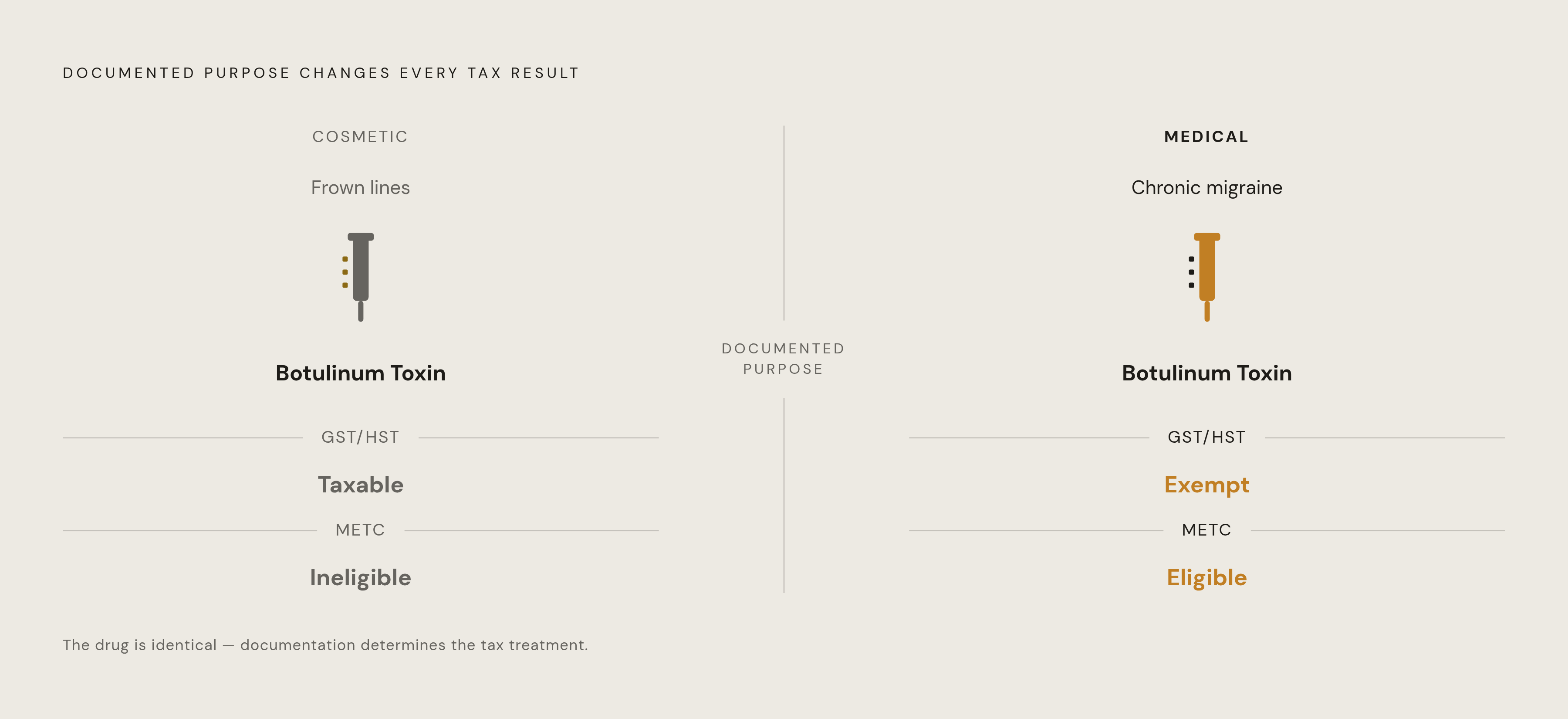
Few examples demonstrate as clearly how completely the purpose test governs the outcome rather than the substance involved as Botox. Botox injected for frown lines is taxable and ineligible. Botox injected to treat chronic migraine, documented as treatment for a diagnosed condition, is generally exempt from GST/HST and eligible for the METC. The drug in the syringe is identical in both cases. Only the documented purpose behind the injection changes the tax result, and that is the purpose test working exactly as the statute intends.
Where classification is genuinely contested: dual-purpose and bundled procedures
The purpose test holds up well at the extremes. It gets harder in the middle, where a procedure carries both a medical reason and a cosmetic one, and the tax outcome turns on which purpose was primary and how the service got billed. When a procedure looks cosmetic but the taxpayer believes a medical reason justifies it, CRA guidance again points to the same fix: a detailed written description from the authorized medical practitioner explaining the purpose of the service. In practice, many patients don't gather that kind of documentation at the time of treatment, which leaves them exposed later even when a genuine medical reason existed.
Bundled service packages raise the stakes further. When the cosmetic element is the main purpose of a package, the CRA treats the entire package as cosmetic and taxable for GST/HST purposes. When two elements are billed and supplied separately, each gets assessed on its own terms. A single price covering a mixed package is generally treated as fully taxable if the cosmetic element predominates, and fully exempt if the medical element predominates instead. There's no partial credit for a bundled invoice; the dominant purpose decides the whole package.
These disputes appear most often in the fast-growing med-spa industry, where medical and aesthetic treatments often happen in the same appointment. Blending a medical treatment with a cosmetic one in a single visit makes it hard to pull the eligible portion apart from the ineligible one once the appointment is over. Provincial rules add another wrinkle: whether a given type of practitioner counts for tax purposes can vary by province, so a procedure eligible in one province might not be recognized the same way in another, and a taxpayer needs to check the rule for their own province rather than assume the federal answer settles it everywhere. The strongest argument against the all-or-nothing treatment of bundled services is that it penalizes a patient who legitimately received both a medical service and an aesthetic one in a single visit. The fix is procedural: separate billing and separate clinical notes for each component protects the eligible part of the claim, and that need for clean separation drives the documentation standard covered next.
What documentation needs to say to survive CRA scrutiny
Because the burden of proof sits with the claimant and purpose is decided case by case, the paper trail built at the time of treatment, not what the patient remembers or believes months later, is what a claim must stand on under review. The core set of records needed includes invoices and receipts that show the provider's name, the date, the service performed, and the amount charged; proof that payment was actually made; practitioner authorization and facility licensing information where relevant; prescriptions or referrals for any service that requires one; and insurance statements showing what was reimbursed and what was left unpaid out of pocket.
For any procedure at risk of being read as cosmetic, the most important additional document is a written statement from the authorized medical practitioner describing the nature and purpose of the service. That statement works best when it's charted in the clinical record at the time of treatment rather than written up after the fact when a claim gets questioned. The CRA's own medical expenses guide notes that certain expenses need specific certification, a prescription, or a supporting form, so each expense category needs to be checked against its own requirement rather than assuming a simple receipt will do.
The GST/HST line on the invoice still matters here too. If a provider charged HST, that's a signal the provider classified the procedure as cosmetic, and anyone trying to argue eligibility for the METC will need to address that signal directly, since the income tax and sales tax classifications aren't independent of each other. Finally, these records don't need to go in with the tax return itself. They need to be kept and ready if the CRA ever asks for them, and not having them on hand at audit time counts the same as never having had them. None of this documentation guarantees a claim gets approved where the underlying purpose is genuinely mixed, but it gives a claim the best chance of surviving scrutiny when the facts actually support it.
Employer health spending accounts and the purpose test
The same purpose-based line that separates eligible medical expenses from cosmetic ones under the METC governs employer health spending accounts too. An HSA only reimburses expenses the CRA already treats as eligible medical expenses, so the rule governing a personal tax credit is the same rule governing what an employee can submit through a workplace plan.
An HSA is a structure defined by CRA rules, and the same subsection 118.2(2.1) exclusion that keeps cosmetic procedures out of the METC keeps them out of HSA reimbursement as well. A cosmetic procedure denied under the personal credit is denied through the HSA too. Submitting cosmetic or lifestyle expenses through an HSA carries a risk beyond that one claim getting rejected: it can draw CRA attention to the plan as a whole. That is why plan administrators require claims to be backed up as CRA-eligible before they pay out.
For a small business running an HSA for its employees, the practical lesson is the same discipline covered in the documentation section above. Clinical purpose charted by the practitioner at the time of treatment, and receipts that clearly describe the nature of the service, are what an employee needs on hand to get a borderline claim approved. A well-run HSA actually has an advantage here over the personal tax route: because each expense gets checked against CRA eligibility rules before reimbursement happens, an employee learns right away whether a specific procedure qualifies, rather than finding out months later at personal tax time that a claim they thought was safe gets disallowed.
Applying the purpose test: a summary across common procedure categories
Across every category of procedure covered in this piece, the pattern holds steady. A procedure qualifies as an eligible medical expense when a diagnosed condition drives it and the record documents that purpose clearly. The same procedure fails when it's performed for appearance alone, with no medical rationale behind it.
Surgical procedures split the same way. Medically necessary private surgery, orthopedic repair, gallbladder removal, hernia repair, cataract surgery, qualifies without much debate, since the medical necessity is built into the procedure itself. Reconstructive surgery after mastectomy or to correct a birth defect qualifies for the same reason. Purely aesthetic surgery with no corrective goal, plain rhinoplasty or body contouring through liposuction, does not.
Injectable and dermatological treatments follow the Botox pattern closely. The same drug or the same category of treatment can sit on either side of the line depending on the diagnosis behind it: Botox for migraine treatment qualifies, Botox for frown lines does not. Laser hair removal tied to a diagnosed condition like PCOS qualifies; laser hair removal chosen for appearance alone does not.
Dental procedures separate on function versus appearance. Braces that correct a misaligned bite qualify; braces chosen only for a straighter-looking smile do not. Veneers placed to repair decayed or misaligned teeth qualify; veneers placed purely to improve the look of healthy teeth do not. Teeth whitening fails the test in every case, since no medical rationale exists for it.
Gender-affirming and other reconstructive procedures qualify when a physician treating a diagnosed condition recommends them and documents the medical necessity behind the recommendation. The same logic extends to excess skin removal after major weight loss, which qualifies when infection risk is the documented reason for the procedure.
Every one of these categories runs through the identical test. The procedure, the practitioner, and the paperwork all answer to the same question: was this purely cosmetic, or did a genuine medical purpose drive the decision? Get that question answered clearly, in writing, at the time of treatment, and the classification takes care of itself.