Orthodontic and Dental Expense Eligibility Under a PHSP
PHSPs reimburse dental care from dollar one if treatment corrects or restores, not enhances.

A dental bill lands differently than most medical expenses. For self-employed Canadians and small-business owners without group benefits, dental care is typically the largest health cost they pay out of pocket, and it comes straight out of after-tax income. A filling here, a cleaning there, and then an orthodontist quotes a treatment plan running into the thousands. That's when the question of what's actually reimbursable stops being theoretical.
Families with kids in braces feel this most acutely. Families with children in orthodontics face multi-year treatment costs that make the question of PHSP eligibility financially significant, not academic. Growing employer adoption of HSAs means more employees will attempt to submit dental and orthodontic claims, and more business owners need to understand what they can and cannot approve. PHSPs themselves are widely used, having been adopted by thousands of small business owners across Canada as a cost-effective alternative to traditional health insurance for providing health and dental benefits.
What a PHSP is as a tax structure for dental reimbursement
A Health Spending Account, when structured properly as a Private Health Services Plan, is what makes dental reimbursement tax-advantaged in the first place. Employer contributions are deductible for the business, and the money employees receive back is non-taxable, a structure defined under the Income Tax Act and clarified further by CRA Interpretation Bulletin IT-339R2. That interpretation bulletin was issued by CRA in August 1989 under the title "Meaning of Private Health Service Plan," and it references the requirement that a PHSP be a plan in the "nature of insurance". The rule that decides what actually qualifies for reimbursement sits in Section 118.2(2) of the Income Tax Act, and every dental eligibility call traces back to that section.
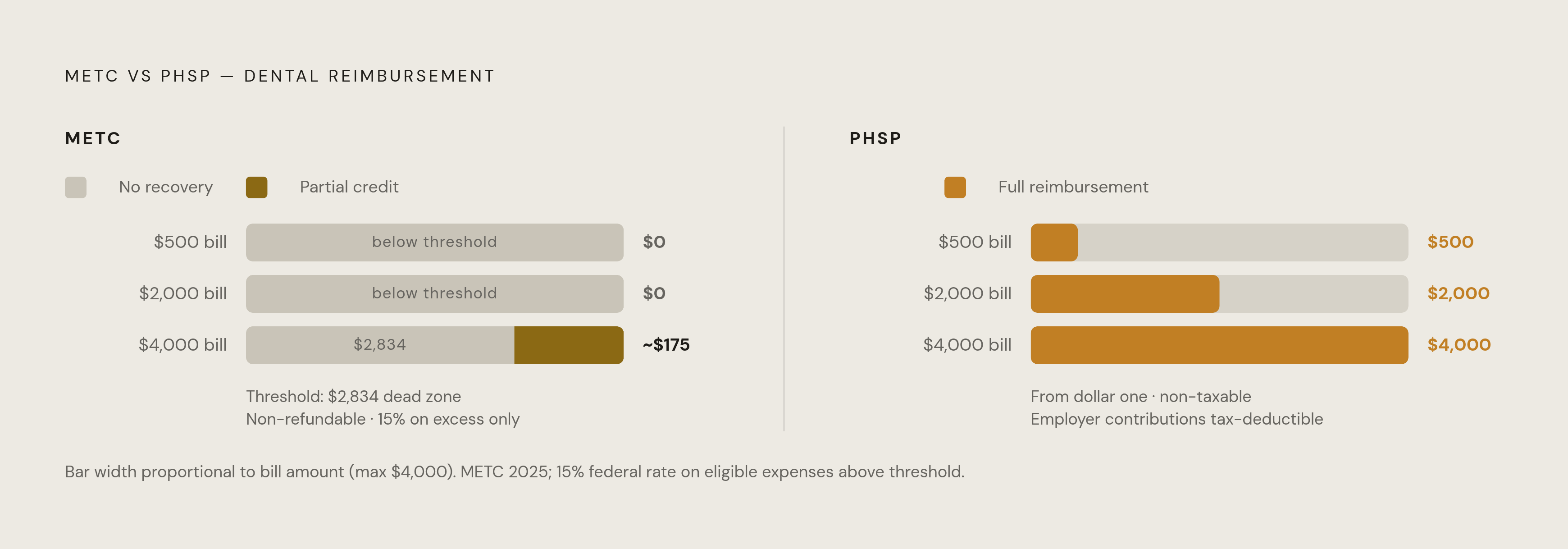
Compare that to the alternative most people default to: claiming dental costs through the personal Medical Expense Tax Credit. The METC only kicks in above a threshold, $2,834 for the 2025 tax year, and even then it's a non-refundable credit rather than a dollar-for-dollar reimbursement. A PHSP, by contrast, pays out from the first dollar spent, within whatever budget the plan sets.
One structural detail matters before going further: CRA guidance from IT-529 states that if a plan is set up so there's essentially no risk the employee won't get reimbursed, it may fail to qualify as a genuine plan of insurance, and without that insurance nature, it isn't a PHSP at all. How a plan is administered matters just as much as what it covers, though that's a separate question from what this piece covers.
The principle that governs all dental eligibility: medically necessary care versus cosmetic enhancement
Every eligibility decision CRA makes about dental expenses comes down to one distinction: care that diagnoses, treats, corrects, or restores is eligible; care that exists purely to make teeth look better is not. CRA made this explicit by excluding purely cosmetic procedures, both surgical and non-surgical, for anything incurred after March 4, 2010.
That single sentence, treat and correct versus enhance, does almost all the work in this article. It's also why the provider doesn't matter nearly as much as the purpose. Dentists are licensed and authorized to practise in every province and territory in Canada, so the dentist's legitimacy was never in question. CRA's guidance frames eligible expenses broadly as those connected to medical care, diagnosis, treatment, or maintaining health, which is consistent with why purpose rather than provider drives the eligibility decision. What matters is the procedure a dentist performs and why. Everything that follows, from the list of eligible procedures to the orthodontic gray zone to the cosmetic exclusions, is this one principle applied to a specific case.
Eligible dental procedures and documentation for a clean claim
Because the governing rule is medical necessity, the range of eligible dental care turns out to be broad. Routine and complex procedures performed by a licensed practitioner qualify under Section 118.2(2), spanning preventive, restorative, and surgical treatment. That includes basic diagnostic work like exams, cleanings, and x-rays, and it extends into restorative work such as fillings, crowns, and bridges. Root canals, extractions, and oral surgery are covered on the surgical and endodontic side, along with treatment for gum disease. Dentures and dental implants fall under prosthetic care, and orthodontic treatment, including braces and clear aligners like Invisalign, is eligible for both adults and dependants. Emergency dental care rounds out the list.
The practitioner performing the work also has to be properly licensed. Dentists, dental hygienists, dental surgeons, dental technicians, and denturists can all generate valid claims, provided they're authorized to practise under the laws of the province where the service happens.
Getting reimbursed cleanly comes down to paperwork that's more straightforward than most people expect. A receipt needs to show the treatment performed, the date of service, the patient's name, the provider's name, and the amount paid. If another insurer or the Canadian Dental Care Plan already covered part of the bill, only the remaining unpaid balance can go through the PHSP. That means employees need to attach their explanation of benefits whenever another plan has already paid something.
Orthodontic treatment coverage and the eligibility line for adult cases
Orthodontics gets its own attention because it's both the highest-dollar dental claim most families ever submit and the category where the eligibility line gets blurry. Braces and clear aligners such as Invisalign are explicitly named as eligible for adults and dependants alike across most sources, though one provider's list mentions only braces without naming aligners specifically.
For kids and teens, this is rarely a close call. Correcting a developing bite or jaw misalignment in a growing child is squarely corrective, and these claims get approved routinely.
Adult orthodontics is where things get less tidy. Neither Section 118.2(2) nor IT-339R2 spells out precisely what counts as "medically necessary" when an adult seeks alignment treatment, and that vagueness opens real ambiguity for cases that are corrective in part but cosmetically motivated in practice. In principle, a claimant could route what's substantively a cosmetic straightening job through a PHSP by framing it as corrective. CRA's post-2010 cosmetic exclusion exists specifically to catch this, but audits are infrequent, and the line between corrective and cosmetic stays genuinely fuzzy for a lot of adult cases, a consideration for anyone advising a client through this decision.
None of this should discourage legitimate adult orthodontic claims. Most are corrective, and most get approved without issue. Documentation carries more weight for an adult case than it does for a kid's case: a treatment plan from the orthodontist describing the clinical basis for treatment does more to protect a claim than an invoice alone ever will.
What is not eligible: cosmetic dental procedures and the post-2010 exclusion rule
Anything purely cosmetic is off the table for expenses incurred after March 4, 2010. Teeth whitening, whether done in-office or at home, falls outside eligibility, and so do veneers applied strictly to improve appearance rather than to fix damage. Non-prescribed mouthguards are excluded too, and the same goes for any procedure whose only purpose is aesthetic.
The test that decides all of this isn't the category of procedure, it's the purpose behind it. A veneer placed to repair a tooth damaged by decay or trauma can be eligible, while the identical veneer placed on a healthy tooth purely to improve its look is not. Same material, same chair, same dentist, different outcome, because the reason for the work is what CRA actually evaluates.
Submitting a cosmetic expense under a PHSP isn't a victimless mistake. If CRA determines the expense doesn't meet the Section 118.2(2) definition of a medical expense, the reimbursement can get challenged as a taxable benefit, and that creates exposure for the employee and the employer both.
How PHSP structure limits how much of a dental or orthodontic bill can be claimed
Meeting the eligibility test under Section 118.2(2) gets an expense in the door, but it doesn't decide how much of the bill actually comes back. Eligibility under Section 118.2(2) is a necessary condition for reimbursement but not a sufficient one: the amount that can actually be claimed is bounded by the plan design and, for some business structures, by CRA-imposed contribution limits.
Incorporated businesses have more flexibility here. There's no CRA-defined dollar cap per employee, only a general requirement that contributions stay reasonable, commonly benchmarked against a sensible percentage of the employee's gross annual salary.
Sole proprietors face a tighter setup. CRA guidelines in IT-339R2 cap contributions more strictly when the business doesn't have enough arm's-length employees relative to its total workforce, and if there are no arm's-length employees at all, a cost-plus PHSP may not qualify as a plan at all. Where it does qualify, the caps generally run to a set maximum for the proprietor and their spouse individually, plus an additional allowance per child.
That structure creates a real squeeze for sole proprietors with multiple kids in orthodontic treatment running two or three years. The bill can easily exceed what the sole-proprietor caps allow in a single year, which turns incorporation, or restructuring the plan itself, into a genuine planning conversation rather than a hypothetical one.
Incorporated employers with staff work differently. The employer sets the plan budget, employees submit eligible claims against it, and the employer only pays out as claims come in rather than paying fixed premiums whether or not anyone uses the benefit.
How the Canadian Dental Care Plan changes PHSP claims
The Canadian Dental Care Plan is active now for eligible lower-income Canadian residents. Applications for the 2026-2027 benefit period are open, while renewals for the 2025-2026 period have already closed.
For an employee who holds CDCP coverage, coordination of benefits governs the claim. Only the portion of the bill left unpaid after the CDCP contributes its share can go through the PHSP, since the PHSP can't reimburse anything the CDCP has already covered. In practice, this adds a documentation step: the employee needs to supply the CDCP's explanation of benefits showing what was already paid before the PHSP can process the remainder. Plan administrators should build this into their claims workflow directly. A claim that arrives without the CDCP amounts netted out should get flagged and sent back for the missing documentation before it's approved.
None of this touches employees who earn above the CDCP income threshold. For them, the PHSP keeps functioning exactly as it always has, reimbursing eligible dental expenses from the first dollar spent within the plan's budget.
The GST/HST change for orthodontic providers and its effect on claim amounts
A regulatory shift outside the PHSP rules themselves also affects claim amounts. CRA issued GST/HST Notice 339 in October 2024, revoking a long-standing arrangement with the Canadian Dental Association that had let GST/HST-registered dentists attribute a portion of orthodontic fees to orthodontic appliances for input tax credit purposes.
That arrangement had run since 1991 and allowed dentists to treat up to 35 percent of total orthodontic fees as attributable to the physical appliances themselves. Its revocation changes the underlying cost structure orthodontic providers operate under. The change could lead orthodontic providers to adjust their pricing, which may in turn affect the amounts PHSP claimants see on their claims.
Sources
- Are Dental Expenses Covered by Your HSA in Canada? | Hiveworks
- PHSP Eligible Expenses
- Private health services plan
- CRA Medical Expense Tax Credit 2025 & 2026 — Eligible Expenses, Claim Rates & Caps
- Private Health Services Plan (PHSP) - Dental Expense Tax ...
- TaxTips.ca - Small Business - Private Health Services Plans (PHSPs) and Health Spending Accounts (HSAs)
- What Is a PHSP? HSA vs Private Health Services Plan in Canada | Hiveworks
- Medical Expenses 2025 - Canada.ca