EFT Reimbursement Workflows in Canadian Digital HSA Platforms
How five EFT stages move Canadian HSA claims from receipt to bank account.

A Health Spending Account in Canada isn't a debit card you swipe at the dentist. It's a workflow: eligibility check, employer billing, fund transfer, each with its own timing and its own rules. That chain explains why one claim clears in three days and another sits for two weeks.
Legally, an HSA is a Private Health Services Plan (PHSP) under CRA rules, and that classification is the whole reason the money moves tax-free. Employees pay out of pocket first, submit a claim, and get reimbursed. The employer sets an annual credit (commonly $2,500 to $5,000 per employee, sometimes far higher for senior staff), and the eligible expense list mirrors the same one CRA uses for the Medical Expense Tax Credit: dental, vision, prescriptions, and more than 100 other categories. Canadian operating companies, non-profits, and sole proprietors with at least one arm's-length employee can open a plan. Holding companies can't.
The fee math shows up again at the invoicing stage. A $200 dental claim gets the employee their full $200. The employer, though, gets billed $200 plus an 8% admin fee plus 5% GST on that fee, landing at $216.80 total. That gap between what the employee receives and what the employer pays is the plan's entire business model, and it explains why the reimbursement never touches a T4 or counts as taxable income, so long as the plan is structured properly as a PHSP.
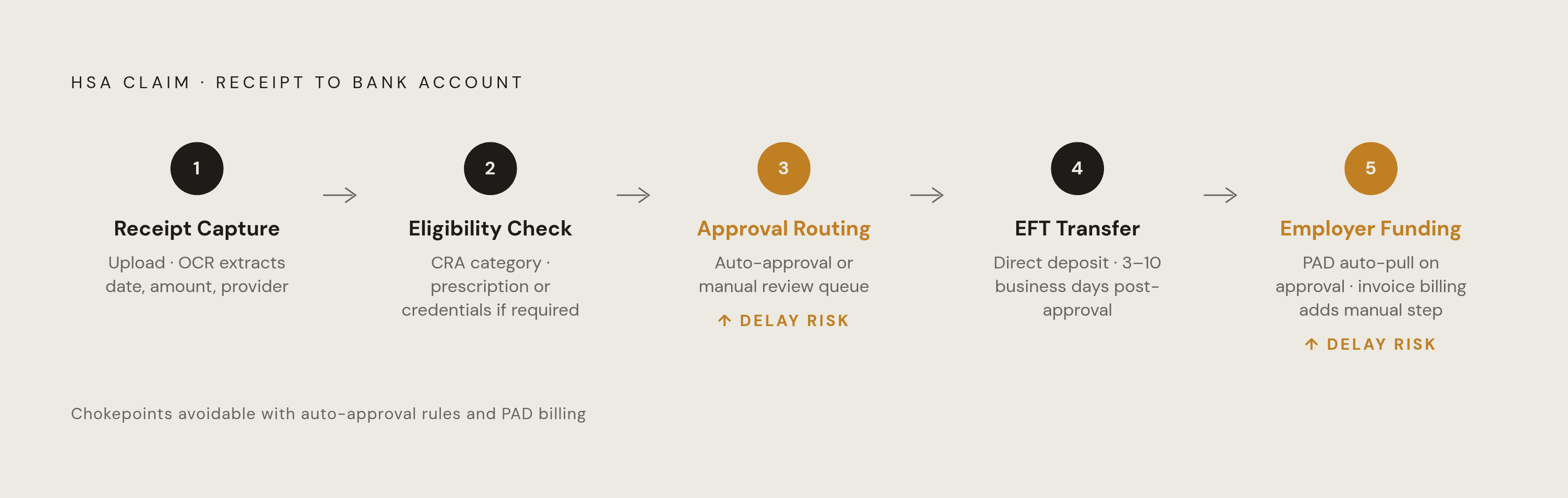
The five-stage EFT workflow that moves a claim from receipt to bank account
Every claim moves through the same five stops, whether it's a $40 vision copay or a much larger orthodontic bill.
Stage 1 is receipt capture. The employee pays the provider directly, then uploads the receipt through the platform's portal, usually from a phone. OCR software pulls the date, amount, and provider name automatically, cutting down on the typos and missed fields that come with manual entry. For remote teams especially, mobile upload isn't a nice-to-have. It's the whole point.
Stage 2 is eligibility cross-reference. The system checks the expense category against CRA's approved list before it goes anywhere near approval. Some claims need more than a receipt: a prescription, practitioner credentials, or written certification, depending on the expense. There's a compliance detail baked into this stage that most employees never think about. CRA sets amount-based thresholds that determine when invoices must include the supplier's GST number, be addressed to the business, or itemize the goods or services. Those requirements feed directly into what a well-built platform needs to validate at submission.
Stage 3 is approval routing. Approved claims trigger mobile alerts to administrators or supervisors, and a well-built platform logs every decision in a way that creates a reliable audit trail. Claims that can't clear automatically (an ambiguous category, missing paperwork) drop into a manual review queue. This is where many delays originate, a point worth remembering later when comparing platforms.
Stage 4 is the EFT itself. Once approved, the reimbursement goes out by direct deposit to the employee's registered bank account. Across platforms, that typically takes 3 to 10 business days after approval. Annual reporting treats the amount as a plan reimbursement, not a payroll event, so it never counts as income. Most platforms also give employees live status tracking, so nobody has to email HR asking where their money is.
Stage 5 is employer funding, and it runs on one of two models. Pre-Authorized Debit (PAD) pulls funds from the employer's account automatically the moment a claim gets approved, no manual sign-off needed. Invoice-based billing works the other way: the employer pays after receiving an invoice, which introduces a step the employee has no control over. Some platforms, such as Coastal HSA, also require an upfront refundable deposit tied to total plan value before claims start funding. Either way, the employer's final bill is the eligible amount plus the admin fee, and the whole thing is deductible as a corporate expense. Most portals also show the remaining annual credit in real time, so employees can plan spending before year-end instead of guessing.
The EFT rails underneath and why the Real-Time Rail matters to HSA timing
EFT payments in Canada run on infrastructure governed by Payments Canada, which sets the rules for how money moves securely between financial institutions. Banks layered on top of that also follow FINTRAC's anti-money-laundering and Know Your Customer requirements. Every transfer leaves a digital trail, which makes account reconciliation and duplicate-payment prevention possible.
The system doing the heavy lifting today is Canada's established EFT infrastructure. It's reliable, it's been the backbone of payroll and direct deposit for years, and it's batch-processed rather than instant. That's the real reason reimbursements take 3 to 10 business days instead of showing up the same afternoon. Money moves in scheduled batches, not the second a claim gets approved.
Payments Canada has been testing a Real-Time Rail (RTR) that would settle payments instantly and carry richer transaction data. Per a 2026 guide from Float Financial, RTR is still in testing as of that writing, but once it launches, it has real potential to shrink the HSA reimbursement window from days to something closer to instant. Payments Canada's updated Bill Payment Framework introduces changes that touch the employer-invoicing side of the HSA workflow directly. And FINTRAC's 2025 reporting updates tighten how recipients get verified and how transaction data gets documented, meaning platforms that register employee bank accounts and move funds need clean, complete records.
None of this is abstract policy trivia. A platform already built to match where Payments Canada's rails are heading is less likely to hit disruption as the infrastructure modernizes underneath it.
Causes of reimbursement delays, and which ones are avoidable
Documentation gaps cause more delays than anything else. A receipt missing an itemized breakdown, a borderline expense submitted without a prescription, an invoice that doesn't meet CRA's documentation requirements for its amount. CRA's medical expense guidance doesn't cover every scenario cleanly either, so some claims genuinely need case-by-case review. A platform that flags those problems at submission, rather than after the fact, saves everyone a week of back-and-forth.
Manual review queues are the second big source of delay. Once a claim can't auto-approve, it needs a human, and platforms without clear escalation rules can let a claim sit indefinitely with no timeline attached.
Funding mechanism matters more than people expect. Invoice-based billing means the employee's reimbursement can get held up until the employer actually pays the invoice, a structural bottleneck that PAD eliminates by pulling funds automatically on approval.
Bank account errors also trip things up: an EFT sent to an unverified or mistyped account simply fails. Platforms that verify recipient name against account details upfront catch this before it becomes a delay instead of after. Timing near year-end adds another wrinkle, since many plans run use-it-or-lose-it, and a claim submitted close to the deadline can collide with normal processing windows. Quebec adds its own layer too, thanks to RAMQ coordination requirements that platforms without Quebec-specific logic may not handle cleanly.
Some of this is fixable, some isn't. Documentation problems and bank registration errors are avoidable with better upfront guidance from the platform. Batch EFT processing windows are not avoidable, not until RTR actually goes live.
The platform technology layer: automated tasks versus human judgment
Automation covers a lot of ground: OCR extraction, CRA category matching, GST threshold checks, balance deduction, PAD debit triggers, audit logging, EFT dispatch, and real-time status updates. Fraud detection increasingly runs on the automated side too, with systems flagging duplicate submissions, provider mismatches, or oddly timed claims that a manual reviewer might just miss.
Human judgment is still required for anything genuinely gray: borderline CRA eligibility calls, brand-new expense categories that don't map cleanly to an existing bucket, ambiguous documentation, and plan design decisions that touch PHSP compliance directly.
Audit trail quality isn't just a convenience feature, either. Employers and employees remain on the hook for their own CRA compliance, and if a plan ever gets reviewed, the platform's logged record of every decision, timestamp, and reviewer action is the employer's actual defense. Some platforms go further, producing spending analytics for finance teams and integrating with payroll or HRIS systems to simplify month-end close.
Buyers should ask a pointed question here: which stages actually require a human to push a button? A platform can automate everything from receipt capture through approval and still need someone to manually trigger the EFT at Stage 4. That's not full automation, no matter what the marketing page says. Cloud-based systems that give remote staff the same mobile upload and balance visibility as in-office employees have become the baseline expectation, not a differentiator.
CRA compliance requirements that run through every stage of the workflow
PHSP status is the whole ballgame. If a plan doesn't meet CRA's PHSP definition, every reimbursement becomes a taxable benefit, and the tax-free advantage disappears. To qualify, the plan has to be sponsored by an actual Canadian corporation, employees need to be arm's-length employees receiving employment income, and the HSA has to be offered as a formal benefit applied consistently within each employee class.
The most common way plans lose their PHSP status is scope creep: gym memberships, personal development courses, anything that isn't a genuine health expense sneaking into the HSA. Those belong in a Wellness Spending Account, which carries different tax treatment entirely, and the eligibility cross-reference stage (Stage 2) is where that boundary needs to get enforced, every time.
Documentation standards flow directly from the "pay first, then submit" structure. The platform has to capture actual proof of payment, such as a receipt or invoice confirming the transaction occurred. The GST thresholds bear repeating here because they're compliance requirements, not just operational nice-to-haves: CRA sets amount-based thresholds that trigger different documentation requirements, including tax-identifier and itemization rules. Carry-forward policy is a plan design choice, but once it's set, whether balances roll over or the plan runs use-it-or-lose-it, the platform has to enforce what the plan document says.
Employers and employees stay responsible for their own tax reporting throughout. A platform administers the plan; it doesn't replace an accountant for edge cases.
Privacy adds another layer entirely, since these platforms handle sensitive health data. PIPEDA governs at the federal level, and provinces with substantially similar legislation apply their own rules on top: Quebec's privacy legislation adds stricter consent requirements, and Ontario has its own rules applying to healthcare providers. A platform operating across Canada has to account for all of it. PIPEDA also requires breach notification whenever a breach creates a real risk of significant harm, and that accountability extends to the platform's own vendors and service providers through contract and oversight.
Comparison of leading Canadian HSA platforms on EFT speed, fees, and workflow automation
Every platform in this space administers a CRA-compliant PHSP, covers the same eligible expenses, and delivers the same core tax outcome. The differences that actually matter come down to reimbursement speed, fee structure, funding mechanism, and how much of the workflow runs without a human touching it.
Fee structures vary in ways that punish careless comparison. Some charge a flat percentage per claim, some add an annual fee, some tack on a per-employee charge, and plenty combine two or three of those. Comparing a single number across providers tells you almost nothing; the number that matters is total cost at a business's actual expected claim volume.
Several platforms stack up as follows, based on fee and process information gathered through mid-2026 (worth confirming directly with any provider before enrolling, since pricing shifts):
Olympia Benefits, founded in Calgary in 1996, charges an 8% admin fee plus a $99 annual fee and a $335 one-time setup fee, with a $40 charge per added employee. Claims typically process in 5 to 7 business days. Incorporated individuals get a separate pricing track starting at $249 a year for the Basic plan. myHSA runs on PAD funding with an advisor-led setup model, blends HSA and Wellness Spending Account design in one plan, and processes claims in 3 to 5 business days. EasyHSA charges a 10% admin fee on approved claims, with pricing confirmed at enrollment. GoKlaim, rooted in Quebec, uses flat-rate pricing and bundles HSA, WSA, and rewards into a single app. Employees photograph receipts, track approvals, and see unused funds roll forward, making it a fit for small businesses that want one system instead of several. Wellbytes targets solo incorporated professionals specifically, with a 10% fee applied to reimbursed amounts on some pricing tiers and no setup fee. Final pricing gets confirmed during setup based on funding model and plan structure. Kibono charges $2.25 plus 5.25% per claim, plus applicable taxes, with no setup or annual fee. Transaction fees can apply depending on whether payment runs through credit card or direct debit. Direct Reimbursement Associates charges fees confirmed at enrollmentm processing fee, positioning itself among the lowest-cost options in the market. One model charges an 8% admin fee on approved claims with zero setup fee and zero annual fee. Cost only accrues when a claim actually gets paid, so a business with no claims in a given month pays nothing that month. That structure suits smaller businesses that want predictable, usage-tied costs rather than fixed overhead sitting on a plan nobody's using yet.
Reimbursement speed falls in a fairly tight band across the industry, generally 3 to 10 business days after approval, though the exact number depends heavily on whether the platform runs PAD funding or invoice-based billing underneath. That funding mechanism, more than any single fee line, tends to be the real difference between a plan that feels instant and one that feels like waiting on the mail.