Incorporated Client HSA Eligibility Review Checklist
Incorporated owners must satisfy four sequential eligibility gates to claim tax-free HSA benefits.

Incorporated business owners don't get automatic access to tax-free health benefits just because they run a corporation. A Health Spending Account lets a business pay medical expenses with pre-tax dollars and reimburse the owner without triggering personal income tax, but it only works when a specific set of CRA conditions line up, and missing one of those conditions makes the tax advantage disappear, sometimes after the claims have already been paid out.
HSA Eligibility for Incorporated Business Owners
An employee at a company with a group benefits plan doesn't think about eligibility. The plan exists, the premiums get paid, and claims get processed. Incorporated business owners don't get that simplicity, because the business structure itself is part of the eligibility test.
Sole proprietors and unincorporated partnerships run into this first. They cannot set up a Health Spending Account for themselves unless the business has at least one arm's-length employee. So the business structure decides whether the owner qualifies at all, before any other question gets asked.
Incorporation changes that answer, but it doesn't settle the matter. An incorporated owner can qualify, but the plan still has to follow the CRA rules for Private Health Services Plans, known as PHSPs. Being incorporated is necessary to get in the door. It isn't enough on its own to walk through it.
There's a real alternative sitting next to all of this: the Medical Expense Tax Credit, or METC. Any individual can claim it, incorporated or not. But the METC is a non-refundable personal tax credit, and it's worth roughly 15% of eligible expenses above a threshold. A properly structured HSA, by contrast, gives the corporation a full deduction and gives the owner a tax-free reimbursement. That gap in value is why getting the HSA structure right is worth the effort it takes.
Why a sequential checklist is the right format for this eligibility review
The eligibility conditions for an incorporated owner's HSA don't function as a flat list of boxes to check in any order. Each one builds on the last. A later condition only matters once an earlier one has been satisfied, so working through them out of sequence produces either false confidence or wasted effort.
The conditions cluster into four groups. First comes business structure: is the incorporation real and active? Second comes the employment relationship: is the owner genuinely an employee, not just a shareholder collecting dividends? Third comes plan design: is the plan formal, administered by a third party, and built correctly for the people it covers? Fourth comes expense and timing compliance: are the claims themselves eligible, and were they submitted inside the right window?
A professional who jumps straight to plan design without confirming the employment relationship first can end up in a bad spot. An owner who takes only dividends might enroll in a plan, pay the administration fees, and submit claims for a year or two, only to have CRA step in and reclassify the entire arrangement as a taxable shareholder benefit under section 15(1) of the Income Tax Act. The plan design was fine. The foundation under it wasn't.
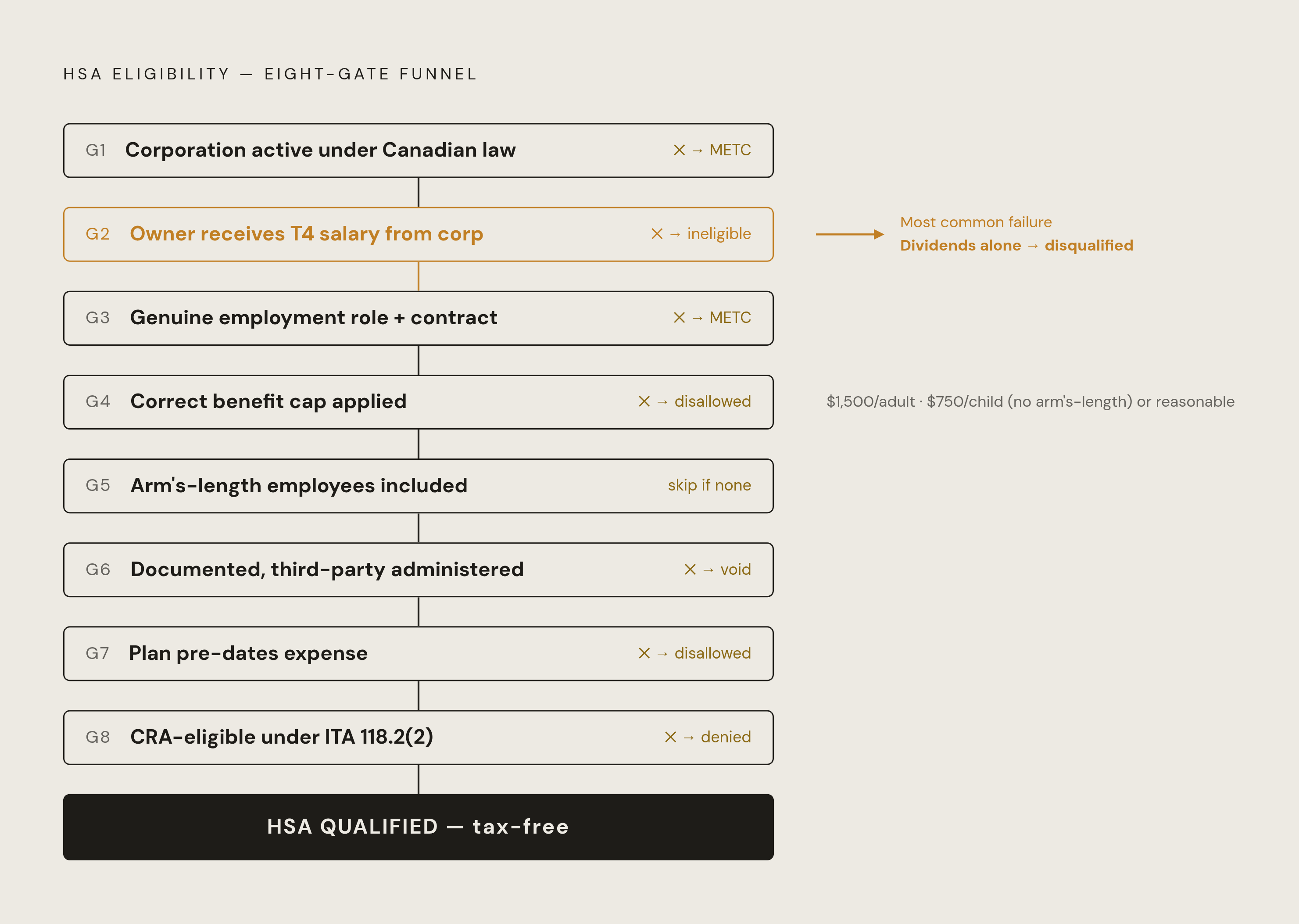
Gate 1: Confirming the business is incorporated and active under Canadian law
The first gate is the simplest one, and most readers working through this checklist will already clear it without much thought. Only an incorporated business can set up a PHSP that gives its owner the full tax advantage, and this gate is binary. There's no partial credit and no workaround.
Professional corporations, CCPCs, consulting corporations, and contracting firms can all clear this gate. Unincorporated businesses, meaning sole proprietors and partnerships, can also open a path to an HSA, but only if they employ at least one arm's-length employee, and the deduction limits that apply to them are stricter. There's no minimum employee count on the incorporated side either: a one-person corporation can set up an HSA just as a fifty-person corporation can.
If the business in question is a sole proprietorship or unincorporated partnership with no arm's-length employees, the checklist ends right here. The HSA isn't available for the owner's own expenses under that structure, and the METC becomes the relevant option instead.
Gate 2: Determining whether the owner has T4 employment income from the corporation
This gate carries more weight than any other on this list, and it's the one where incorporated owners most often trip without realizing it. A PHSP is, by definition, an employee benefit. CRA requires that the person receiving it have a genuine employment relationship with the corporation, shown through active engagement in the business, a formal employment contract, reasonable and comparable benefit levels, and, while helpful rather than mandatory, at least some T4 salary income.
The trouble occurs with owners who take only dividends. From CRA's perspective, a dividend-only owner is a shareholder, and a shareholder's benefits fall under a different set of rules. Taking only dividends puts the arrangement on shaky legal ground: CRA can reclassify HSA reimbursements as a taxable shareholder benefit under section 15(1) of the Income Tax Act. If that reclassification happens, the corporation loses its deduction, the owner owes personal tax on the full reimbursed amount, and interest and penalties can follow on top of that.
Clearing this gate means confirming that the corporation pays the owner a regular salary and issues a T4 slip for it. An owner currently taking only dividends should talk to their accountant about adding at least a modest salary before enrolling in any plan. Many accountants recommend exactly this step specifically to preserve HSA eligibility.
Some HSA providers will enroll a dividend-only owner without raising the issue. Enrollment by a provider doesn't resolve the underlying compliance risk. The gap between what a provider is willing to accept and what CRA will actually sustain in an audit belongs to the business owner, not to the provider who signed them up.
Gate 3: Establishing that the shareholder-employee behaves as a genuine employee
Gate 2 asks about the form of the owner's income: is there a T4, is there a salary. Gate 3 asks a different question about the substance of the relationship: does the owner actually function as an employee of the corporation. CRA treats this as a question of fact, assessed on the specific circumstances of each case.
In CRA's eyes, genuine employment means you are active and regularly engaged in the corporation's day-to-day operations. It looks like an employment contract between the owner and the corporation. It looks like a benefit that flows from the person's role as an employee, not simply from the fact that they hold shares. And it looks like a salary that's consistent with the work being done. A token salary paired with a large HSA claim relative to that compensation draws more attention from CRA, not less.
Clearing this gate means having an employment contract in place, keeping the owner's role active and documented, and making sure the full compensation picture (salary plus any HSA benefit) holds together as something defensible on paper.
Gate 4: Applying the right benefit limits based on whether arm's-length employees exist
Once an owner clears the employment gates, attention shifts to plan design, starting with how big the benefit can be. Whether the corporation employs arm's-length staff decides which cap regime applies, and mixing up the two is one of the most common structural mistakes in owner-operated HSA setups.
When a self-employed individual has few or no arm's-length employees, what CRA calls a "class of one" scenario, annual deduction caps apply under ITA section 20.01. Those caps are currently $1,500 per adult and $750 per dependent child under 18. The caps exist because, without arm's-length employees in the mix, the arrangement looks less like a genuine employee benefit plan and more like personal tax planning.
When arm's-length employees are present, the fixed dollar cap disappears, replaced by CRA's "reasonableness" standard. The benefit level has to be proportional to the employee's salary and role, but there's no CRA bulletin that sets a hard maximum. What counts as reasonable gets assessed case by case, on the specific facts in front of CRA. A common approach ties the benefit to the owner's actual compensation, aiming for something a comparably paid employee at another corporation might plausibly receive.
Clearing this gate means confirming whether the corporation has any arm's-length employees and how many, identifying which cap regime applies as a result, and checking that the proposed annual HSA amount is proportional to the owner's T4 salary and defensible under that reasonableness standard.
Gate 5: Confirming the plan includes arm's-length employees correctly if they exist
This gate only matters if the corporation actually has arm's-length employees. If it doesn't, move on to Gate 6. If it does, the stakes here are higher than many owners expect.
If a plan covers only shareholders while arm's-length employees work at the same corporation and get left out, CRA can treat it as a shareholder benefit. That risk exists even for owners who cleared Gates 2 and 3 cleanly. CRA expects at least one employee class to include at least one arm's-length employee, and the plan can't be structured to cover shareholder-employees while excluding everyone else who sits in the same employee class. Different classes can have different benefit levels, a manager class and a staff class, for example, but the classification has to be consistent and written down.
Clearing this gate means checking that arm's-length employees are included in at least one benefit class, that the employee classes are clearly defined and applied consistently in the plan document, and that the owner's own class genuinely matches their role and pay rather than being built just to justify a bigger benefit.
Gate 6: Verifying the plan is formally documented and third-party administered
A plan can clear every gate above and still fail here if it isn't set up the right way on paper and in practice. A plan that's self-administered or left undocumented doesn't qualify as a PHSP under CRA rules. The formality of the arrangement is itself part of what CRA requires.
A qualifying plan needs written documents that spell out the benefit amount per employee or employee class, a clearly defined plan year, the eligible expense categories and any restrictions on them, and a provision that stops the corporation from unilaterally changing or ending the plan without notice. That last point matters especially for single shareholder-employee setups, where the line between "the business" and "the owner" can otherwise blur. For owner-operated corporations, good practice also includes updating the employment contract to show that the HSA is part of the compensation package being offered.
The owner also can't administer the plan personally. A third party has to process claims and reimbursements. That third-party involvement is what makes the reimbursements credible as genuine business expenses, not personal withdrawals dressed up as something else. The administrator reviews claims, processes reimbursements, and keeps the documentation, while the corporation pays the claim amount plus an administration fee, both of which are deductible.
Record-keeping belongs here too. So the corporation should hold onto every claim receipt, every reimbursement record, and every plan document, in case CRA asks to see them.
Gate 7: Confirming the plan was established before eligible expenses were incurred
This is the easiest gate to pass if an owner plans ahead, and the most frustrating one to fail after the fact. The plan has to be formally established before any expense is incurred. Retroactive enrollment doesn't satisfy CRA's PHSP requirements, no matter how the paperwork gets dated afterward.
That rule has a very literal application. If you set up an HSA in November, you can't submit claims for dental work completed the previous March. The same logic applies to dependants: they generally need to be enrolled when the plan is established, before a cost is incurred that would otherwise need to be covered later.
Clearing this gate means confirming the plan's start date comes before the date of the earliest expense the owner plans to claim, confirming every dependant who will be covered was enrolled before their first claimed expense, and understanding exactly which expenses fall within the documented plan year.
Gate 8: Confirming that the expenses being claimed are CRA-eligible
Even if a plan is structured flawlessly, it only delivers tax-free reimbursements for expenses CRA actually recognizes as eligible medical expenses under section 118.2(2) of the Income Tax Act. The HSA's eligible expense list mirrors the METC list closely.
Eligible expenses generally include dental care such as cleanings, orthodontics, and implants; prescription medications; vision care including eye exams, glasses, contacts, and laser eye surgery; paramedical services like physiotherapy, chiropractic care, prescribed massage therapy, and acupuncture; mental health services, with psychologist visits covered broadly and psychotherapist visits eligible specifically in Ontario and Quebec; fertility treatments; medical devices and equipment such as orthotics, hearing aids, and braces; and private health insurance premiums.
Expenses that fall outside eligibility include cosmetic procedures unless medically necessary, gym memberships, over-the-counter vitamins and supplements unless prescribed, and general wellness products.
To clear this gate, you need to know that only CRA-eligible expenses qualify, no matter what a provider's marketing materials might suggest, and you need to keep receipts for every claim submitted.
One material exception: Quebec-resident incorporated professionals
Clearing all eight gates doesn't guarantee you the same tax outcome in every province. Federal tax treatment of HSA reimbursements as non-taxable doesn't carry over automatically to Quebec, and incorporated professionals there face a different result.
Revenu Québec generally treats employer-paid PHSP coverage as a taxable benefit for provincial tax purposes, even when the same arrangement qualifies for favourable treatment at the federal level. That benefit is typically reported on the employee's RL-1 slip. For a Quebec-based incorporated professional, this plays out in a specific way: the corporation still gets its federal tax deduction, and the reimbursement still stays exempt from federal personal income tax. But that same reimbursement counts as taxable income for Quebec provincial tax purposes.
This isn't a reason to avoid setting up an HSA. The federal advantage still holds. It's a reason for Quebec-resident owners to factor the provincial tax exposure into how large a plan they build, and to work through the numbers with a Quebec-licensed accountant before deciding on a benefit amount. The net advantage is smaller than it would be elsewhere in Canada, with the exact size depending on the owner's provincial marginal tax rate.
What to do once every gate has been cleared
An incorporated professional who has confirmed incorporation, confirmed T4 salary, confirmed a genuine employment relationship, applied the right benefit limits, included arm's-length employees correctly where they exist, documented the plan formally with third-party administration, set a plan start date ahead of any claimed expense, and checked that the claimed expenses are CRA-eligible has cleared every condition that matters. That owner is ready to enroll and start using the plan.
If any gate along the way raised a question, particularly around salary structure, the employment contract, or how employee classes are built, that question should go to the corporation's accountant before enrollment, not after. Beyond that, the remaining steps are straightforward: set the plan's start date before any expense meant to be covered by it is incurred, and keep every receipt and plan document organized in case CRA ever asks for them.
The point of working through this checklist in order is to find out exactly where things stand and what, if anything, still needs attention. For most incorporated professionals who are actively taking a salary and running a genuine operating business, the answer is usually good news: the path is clear, and setting up the plan properly is a matter of days, not months.