PHSP Interaction With Payroll Remittances and CPP/EI
Qualifying PHSP status eliminates CPP and EI withholding on medical benefits.
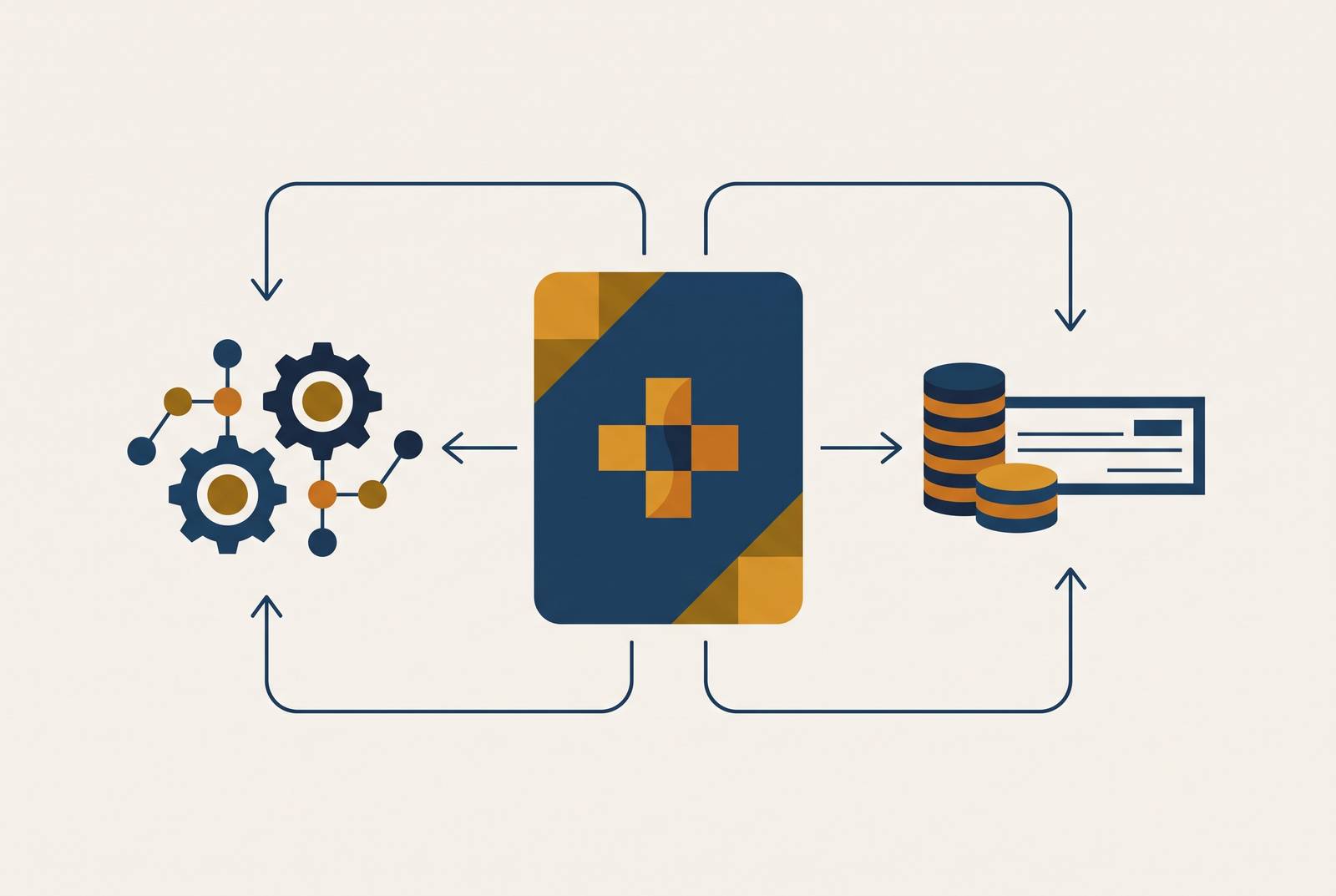
When an employer pays or reimburses an employee for a medical expense, that payment is a taxable benefit by default. The Canada Revenue Agency's guidance on medical expenses states that direct payment or reimbursement of medical examinations or medical expenses counts as taxable employment income unless the payment flows through a Private Health Services Plan that meets CRA's definition. The PHSP exemption is a narrow exception to a broad taxable rule, not a built-in feature of any health-related payment an employer makes.
A plan earns PHSP status only when two conditions hold at the same time. First, every expense the plan covers has to be a medical or hospital expense, or an expense connected to one within a reasonable time, as set out on CRA's medical expenses page. Second, all or substantially all of the premiums paid under the plan have to relate to expenses that qualify for the Medical Expense Tax Credit. Both conditions must be true together. A plan that satisfies one but not the other fails the test.
How that second condition gets measured depends on how the plan is funded. Insured plans are tested against the premiums paid during the calendar year. Self-insured plans are tested against the benefits actually paid out to employees during the year. CRA's own worked example on the medical expenses page shows how this plays out: a plan covering prescription drugs, dental, hospital expenses, and a small slice of non-METC items qualifies because 92% of its premiums relate to METC-eligible expenses, even though the benefits actually paid out that year tell a different story, with a lower share eligible once claims are tallied. The premium calculation and the claims experience can diverge, and CRA's test follows whichever measure applies to the plan's funding structure.
This single definition is the fork in the road for every payroll consequence that follows. A reimbursement either sits inside a plan that satisfies both conditions, in which case it is fully non-taxable, or it sits outside one, in which case it becomes taxable employment income subject to the full set of payroll obligations that apply to wages. There is no partial credit and no proportional treatment. The plan either qualifies or it doesn't, and everything downstream, from CPP withholding to T4 coding to year-end remittance totals, depends on that one determination.
What a Qualifying PHSP Eliminates From Payroll
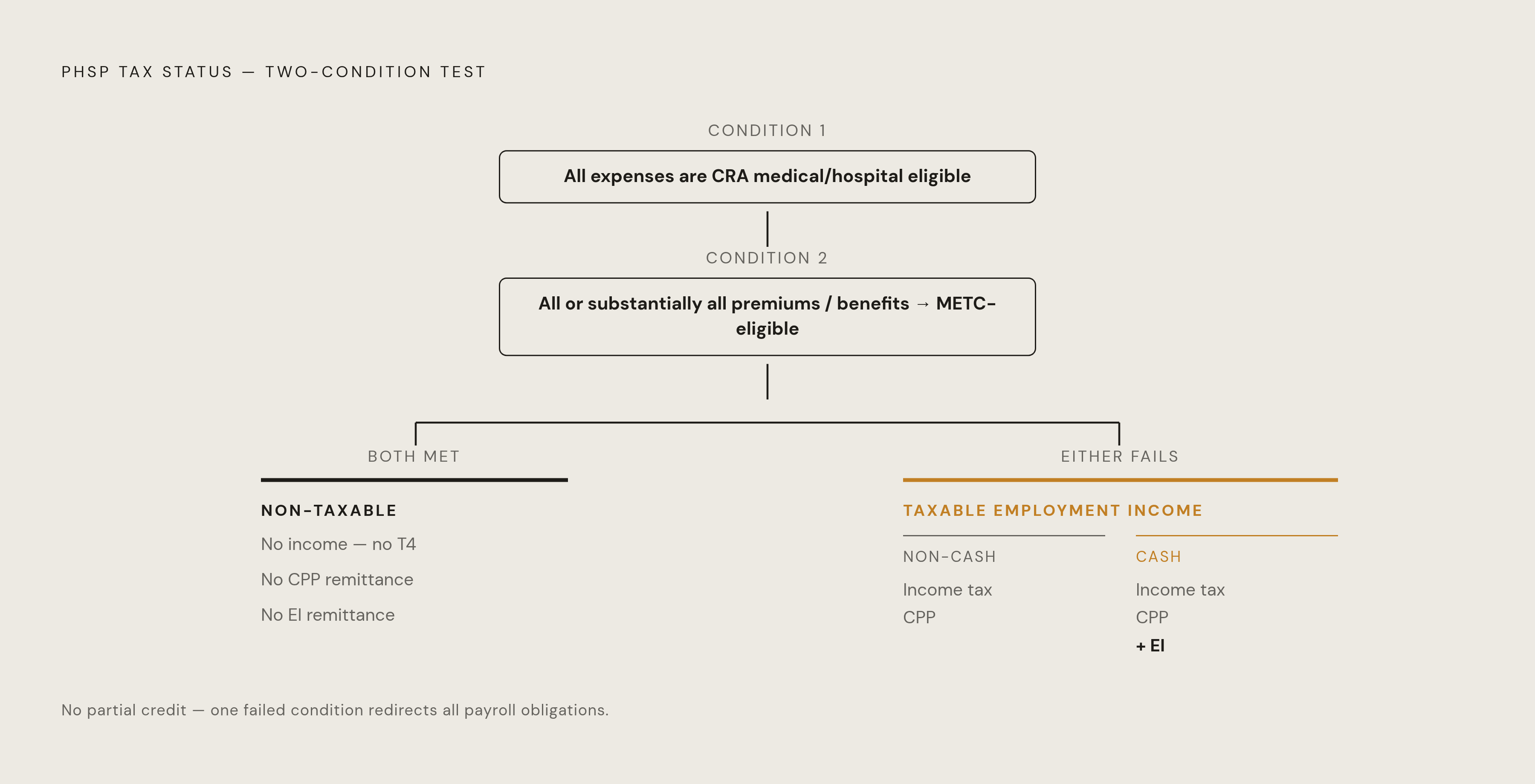
A qualifying PHSP removes three payroll obligations at once. Employer contributions to the plan are deducted as a business expense, and the reimbursed amount never touches the employee's pensionable or insurable earnings base. There's no CPP withholding on it, no EI withholding on it, and no remittance line for it. The benefit amount also never appears on the T4 as employment income. For an employer running a compliant plan, the health benefit is administratively invisible to payroll.
A plan that fails the test triggers the opposite cascade, and the exact shape of that cascade depends on whether the benefit is paid in cash or in a non-cash form. Non-cash or near-cash taxable benefits are subject to income tax and CPP, but not EI. Cash taxable benefits are subject to income tax, CPP, and EI, all three. That asymmetry, CPP applying to non-cash benefits while EI does not, is where otherwise careful payroll processes break down. An employer who correctly identifies a failed PHSP reimbursement as taxable can still get the remittance wrong by applying EI to a non-cash benefit that doesn't call for it, or by failing to apply EI to a cash benefit that does. The form the payment takes, not the underlying medical expense, decides whether EI premiums come into play.
The T4 reporting follows the same split. A taxable non-cash benefit goes into Box 14 as employment income, into Box 26 as CPP/QPP pensionable earnings, and gets flagged with Code 40 for other taxable allowances and benefits. A taxable cash benefit touches those same boxes and also affects EI insurable earnings. There's a separate reporting requirement on the other side of the ledger too: when an employee contributes personally to a PHSP, the employer reports those contributions under Code 85 on the T4, or Code 135 on a T4A for a former employee. That coding lets the employee claim qualifying medical expenses on their own return. It's a distinct obligation from the taxable-benefit reporting above, and it applies regardless of whether the employer's side of the plan qualifies.
How the "all or substantially all" test can silently disqualify a plan mid-year
PHSP qualification is a condition the plan has to maintain all year, not a box checked once at setup, and the same tests that establish qualification at the outset are the tests that can quietly undo it before December 31.
The METC-eligibility threshold is the most common point of failure. Self-insured plans are measured against benefits actually paid during the year, so if employees file more claims for expenses that sit outside METC eligibility, things like massage therapy or certain non-prescription items, the plan's eligible-expense ratio can drift downward over the course of the year without anyone changing the plan document. Insured plans carry less exposure to this particular drift because they're measured against premiums rather than claims, but they're not immune: if the premium structure itself bakes in more non-METC coverage than the threshold allows, the plan fails from the start regardless of what gets claimed later.
When a self-insured plan drops below the required threshold, the failure applies retroactively to every reimbursement made under it that year. Every payment that was treated as non-taxable becomes taxable employment income after the fact, and CPP contributions that were never withheld or remitted are now owed, including the employer's matching share. The CRA's PIER process, the Pensionable and Insurable Earnings Review, is built to catch exactly this kind of gap. PIER checks that the pensionable and insurable earnings reported on T4 slips match the CPP and EI amounts actually remitted, and a misclassified PHSP benefit shows up as a mismatch that generates an assessment, along with penalties and interest on the shortfall.
None of this requires an employer to have done anything wrong at the time the plan was set up. A plan that qualified cleanly on January 1 can fail the test by October simply because employee claims trended toward expenses the METC doesn't cover. The practical response is ongoing monitoring: employers running self-insured plans should track the METC-eligibility ratio of claims as they come in during the year, not just reconcile it after year-end, and give employees clear guidance up front on which expenses the plan is designed to cover. Treating that monitoring as a routine part of plan administration, rather than a one-time setup task, is what keeps the plan inside the line CRA has drawn.
The salary-conversion trap: why reclassifying pay as PHSP contributions backfires
An employer that takes salary an employee is already entitled to and relabels part of it as a PHSP contribution, expecting the relabeled portion to become non-taxable, finds that it doesn't work. The CRA treats the reclassified amount as though it had been paid out of the employee's after-tax income. The employee ends up with a taxable benefit on top of the original entitlement, and the employer gets a deduction for the contribution but no relief on the payroll side.
The reason CRA treats this so firmly comes down to what the PHSP exemption is actually for. It exists to cover health benefits an employer funds on top of compensation, not to let an employer shelter compensation an employee has already earned. If an employee has a legal entitlement to a salary amount, swapping that amount for a PHSP contribution doesn't make the entitlement disappear. The tax character of a payment follows the underlying legal right to it, not whatever label gets attached to the transaction on paper.
The payroll consequence mirrors the salary-conversion trap in other benefit categories. The reclassified amount stays pensionable, so CPP contributions that should have been withheld on it were not, and both the employee and employer portions come due retroactively. If the reclassified amount is structured or treated as a cash benefit, EI premiums apply as well. Because these arrangements tend to persist once set up, the retroactive CPP exposure can span multiple years rather than a single reporting period, compounding the employer's matching obligation each year the structure stayed in place. This design failure traces directly back to the first principle: the PHSP exemption only ever covers genuine employer-funded health benefits, and no amount of relabeling changes what a payment actually is underneath.
The shareholder-employee problem: when the employment relationship itself is in question
For incorporated owner-managers, PHSP compliance involves a second question that has nothing to do with the plan document itself: whether the benefit was received because of employment or because of share ownership. The two produce entirely different tax outcomes, and getting the characterization wrong is costly in a different way than a simple plan disqualification.
CRA's position starts from a presumption. A shareholder who can significantly influence the policies of the business is presumed to receive any benefit because of that ownership stake, not because of an employment relationship, and the burden falls on the shareholder to prove otherwise. If that burden isn't met and CRA determines the benefit flowed from share ownership, the entire reimbursement gets taxed as a shareholder benefit under subsection 15(1). That provision sits outside the employment income system altogether: no CPP applies, no EI applies, and no payroll remittance applies, because it was never employment income to begin with. But the corporation also loses its deduction for the expense. The same dollar gets taxed in the shareholder's hands with no offsetting relief on the corporate side. A Tax Court case referenced in CRA's materials involved exactly this outcome: a shareholder assessed a substantial taxable benefit under subsection 15(1), with the corporation denied a deduction for the same expenses, producing a double-taxation result neither side could undo after the fact.
The practical fix for an incorporated owner-manager is the same discipline that applies to salary conversion: the PHSP has to be structured as part of a genuine employment relationship, with coverage set at a level the business would reasonably extend to an arm's-length employee doing comparable work. When that characterization holds and the plan qualifies, the outcome is the same clean result available to any employee: no CPP, no EI, no payroll remittance on the reimbursed amounts. When the characterization fails, the owner-manager faces a subsection 15(1) assessment, the corporation loses its deduction, and no payroll treatment applies. That's a categorically different outcome than an ordinary PHSP disqualification, where at least the amount becomes a deductible, payroll-taxed benefit. Here, the corporation gets nothing and the shareholder still pays.
CPP2 and the Cost of a Misclassified PHSP Benefit
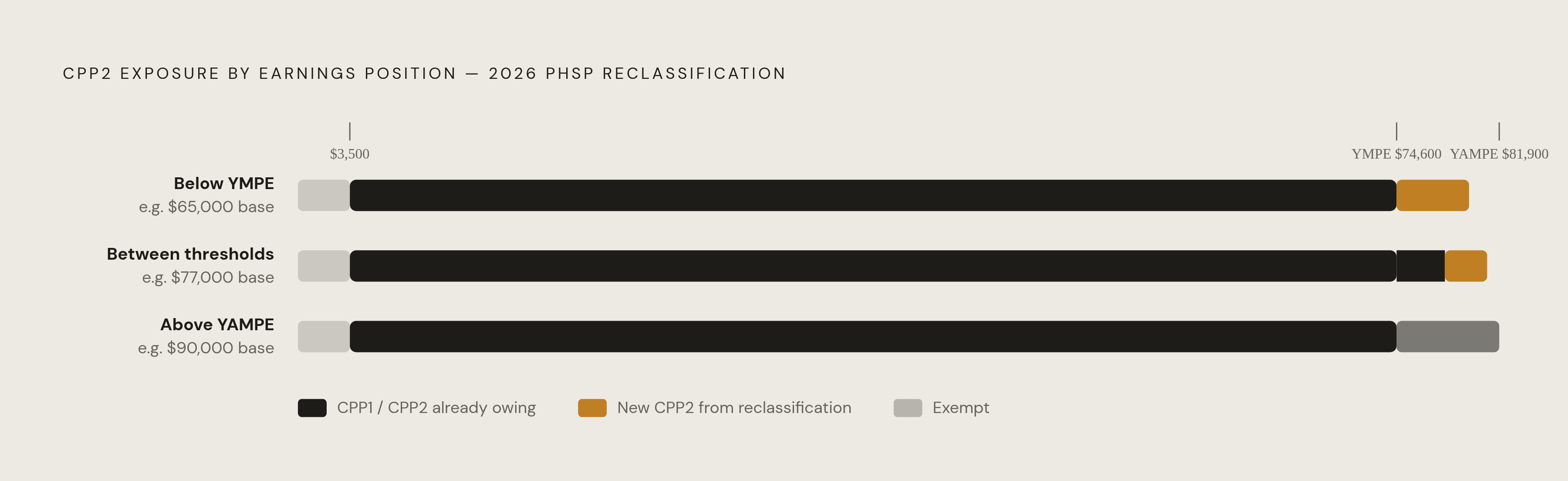
Since January 1, 2024, employers calculate CPP contributions across two tiers instead of one, and that change has made a PHSP reclassification error materially more expensive for employees earning near or above the first earnings ceiling. A taxable benefit that didn't carry any second-tier cost before 2024 now can.
CRA's CPP contribution rates table sets the 2026 structure. The YMPE, the first ceiling, marks the upper bound for standard CPP contributions, and the regular CPP rate applies to earnings between the basic exemption and that ceiling, with both employee and employer facing a maximum contribution under this first tier. Above the YMPE sits a second band: CPP2 applies at a separate rate on earnings between the YMPE and the YAMPE, the second ceiling, and both employee and employer face their own separate maximum contribution under that second tier.
Reclassification interacts with both tiers depending on where the employee's earnings already sit. An employee earning below the YMPE whose taxable PHSP benefit pushes reported earnings above the $74,600 threshold for 2026 now generates CPP2 obligations that would never have existed had the plan simply qualified, and those obligations fall on both the employee and the employer. An employee already earning above the YMPE generates additional CPP2 employer cost on the reclassified amount, up to the YAMPE ceiling. Either way, the employer ends up remitting a two-tier CPP liability on an amount that a compliant PHSP would have kept off the payroll calculation.
The YMPE for 2026 is higher than the prior year's ceiling, and CRA has set that threshold on an upward path. As the YMPE rises each year, more employees move into the earnings range where CPP2 applies. The population exposed to this two-tier cost on a misclassified PHSP benefit keeps growing. A compliance gap that might have cost an employer a single CPP remittance a few years ago now carries a second contribution layer for a wider group of employees.
The EI Premium Reduction Program: a separate payroll lever available alongside a qualifying PHSP
A qualifying PHSP, by itself, doesn't lower EI premiums. It removes the reimbursed amount from the payroll calculation entirely, but it doesn't touch the employer's EI rate on the earnings that remain. A separate program handles that: an employer who adds a qualifying short-term disability plan alongside the PHSP can apply for a reduced employer EI rate through the EI Premium Reduction Program. The two programs work on different parts of the payroll calculation and don't substitute for each other, but they're designed to work together. For 2026, the program is projected to return about $1.46 billion in savings to participating employers and employees that year. An employer that has already built a compliant PHSP and is looking for the next payroll lever to pull has this program as a direct next step, layered on top of, not instead of, the PHSP structure already in place.
Sources
- Medical expenses, including payments from a private health services plan (PHSP) - Canada.ca
- CPP contribution rates, maximums and exemptions
- Employment Insurance - Important notice about maximum insurable earnings for 2026 - Canada.ca
- Employers’ Guide
- Pensionable and insurable earnings - Canada.ca
- Second additional CPP (CPP2) contribution rates and maximums