Communicating PHSP Tax Savings to Non-Technical Clients
Show employees what the full dollar means compared to a salary increase after tax.

Explaining Private Health Services Plan (PHSP) tax savings to non-technical clients starts with dollars. Show what the business spends and what the employee keeps, then explain the conditions behind those results. Clear language does not mean leaving out the rules.
Why most PHSP conversations fail before the savings number lands
A client who disengages during a tax explanation is not necessarily skeptical about the benefit. The explanation may simply be arriving backward. Starting with the Income Tax Act, a Canada Revenue Agency bulletin and an eligibility tree asks the client to learn the structure before seeing its value. By the time the saving appears, the client has lost the thread.
Terminology switching adds another obstacle to an already unfamiliar subject. Health Spending Account and Health Care Spending Account are common provider names, often shortened to HSA and HCSA. Those labels do not explain the tax result. Define the name the client encounters, then use PHSP consistently rather than making one arrangement sound like several products.
The two tax advantages a PHSP delivers, stated plainly
With a qualifying PHSP, the business deducts the eligible cost as a business expense. The employee gets the eligible reimbursement without paying income tax on it. These benefits apply to the same medical expense, rather than requiring the client to choose between them. That is the foundation of the explanation.
For the corporation, the deduction reduces taxable income by the eligible claims and the administration fee. For the employee, the reimbursement does not appear as income under the qualifying tax treatment. Explaining them separately helps a client understand whose tax bill changes, without getting tangled in how the arrangement is administered.
HealthSmart PHSP describes a pay-per-use arrangement in which no cost is incurred until a claim is made, rather than monthly premiums being paid for unused benefits. That describes the reimbursement model within a range of qualifying arrangements that can be insured or self-insured. It is not a savings account, investment vehicle or wellness allowance. Giving it one of those labels would create the wrong expectation about what the money can fund.
How to show a business-owner client what the deduction is actually worth
The distinction between a deduction and a refund of the bill belongs in the owner conversation early. Saying that an expense is fully deductible tells the client how much reduces taxable income, but not what the saving is worth to that business. The useful comparison is the cost of funding the same medical expense with and without the plan.
For that conversation, use a two-column table headed “Without PHSP” and “With PHSP.” The first column follows the owner’s money from pre-tax corporate income through corporate and personal tax to the amount available for the medical bill. That exposes the hidden cost of paying personally. The bill alone does not show how much income was needed to fund it.
The second column shows the corporation paying the eligible expense and administration fee, then deducting both. Show the gross pre-tax income needed, tax paid, net cost and difference across the two paths. Keep the fee visible in the comparison.
The Medical Expense Tax Credit provides another useful reference point for an owner who already claims medical expenses personally. It can provide tax relief, but a PHSP can produce a substantially larger saving on the same expenses, with the gap widening at higher income levels. The advisor’s job is to put the two outcomes beside each other using the client’s circumstances.
How to show an employee client what tax-free reimbursement means compared to a salary increase
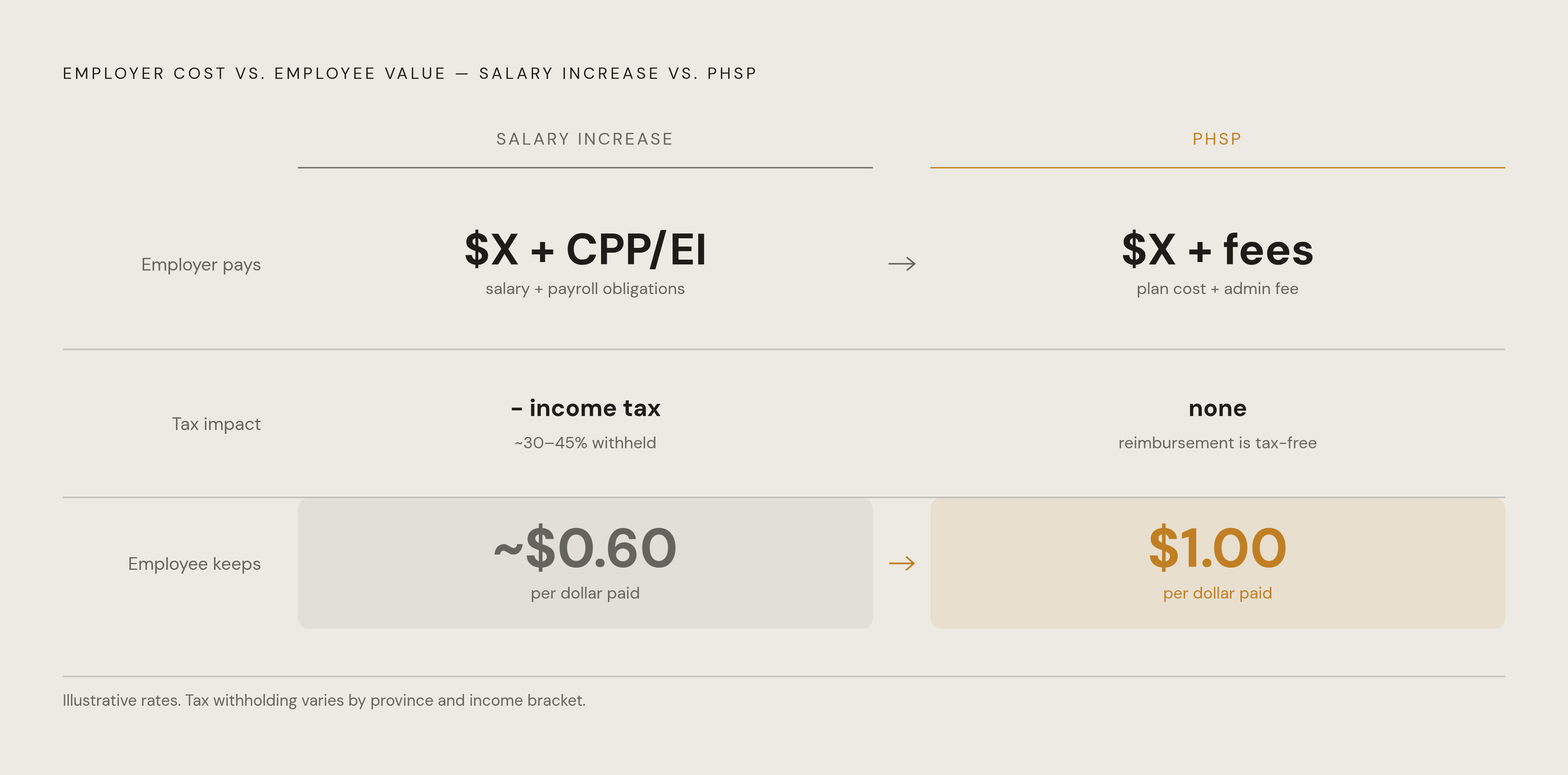
An employee needs to start with what reaches their pocket. A salary increase is familiar, so it gives the advisor a clear comparison for explaining reimbursement without beginning with the employer’s tax position. For eligible healthcare spending, the contrast is between an amount reduced by income tax and a reimbursement received in full.
Use a side-by-side table to compare a salary increase with a PHSP allocation of the same amount. Show what the employer pays all-in and what the employee keeps under each route. The salary column includes the employer’s payroll obligations and the employee’s after-tax amount. The PHSP column shows the eligible reimbursement received after a receipt is submitted, with plan costs reflected in the employer’s total.
Keep what is said close to what those columns show. “You receive the full dollar. A salary increase would give you less than that after tax.” The comparison concerns money used for eligible medical expenses. An allocation is not a payment simply because it appears in the table.
HealthSmart lists dental, vision, prescriptions and massage therapy among claimable expenses, subject to the eligible medical expense rules. These are easier to picture than “tax-advantaged compensation.” The table supplies the financial contrast, while the expense examples show where the benefit fits into the employee’s life.
Who actually qualifies, and how to explain the boundaries without losing the client
The value case must lead into an honest eligibility conversation. The proposed treatment must fit the client’s business structure and the way the owner gets paid. The clearest starting case is an incorporated employer providing employee benefits, including coverage for an owner-employee, spouse and dependent children. A one-person corporation can establish a plan, but that does not settle whether its particular arrangement qualifies.
Salary and dividends cannot be treated as interchangeable here. The owner must be on payroll and receive T4 income. A shareholder receiving only dividends is not an employee for PHSP purposes and cannot assume either the business deduction or tax-free reimbursement applies.
Sole proprietors and partners face a different boundary. Their deduction depends on coverage also being offered to employees and is proportional, with annual limits applying. The stated limits are $1,500 per proprietor, spouse or dependent aged 18 or older, and half that amount per dependent under 18.
Quebec also needs its own version of the comparison because the provincial saving is smaller, though still real. The plain-language bridge is that eligibility depends on business structure and how the owner pays themselves, while the saving depends on the applicable tax treatment. Before proceeding, refer the client to their accountant for a determination specific to their situation.
The compliance boundary clients must understand before they sign up
Being on payroll is not the final qualification test. At the 2022 CALU Roundtable, the Canada Revenue Agency raised a concern about plans for a sole shareholder-employee. A plan for that shareholder and family members may qualify as insurance only when the corporation is truly assuming risk.
The agency’s concern rests on the likelihood of full reimbursement of the annual allocation and the owner’s control over the arrangement. The corporation can modify or terminate it at its sole discretion, without notice. In that situation, the arrangement can amount to an individual paying personal medical expenses through a corporation they control. Reimbursements can then become taxable benefits.
The “all or substantially all” test creates a separate boundary around eligible medical spending. For an insured plan, the test applies to premiums paid during the calendar year. For a self-insured plan, it applies to benefits paid to all employees during that year. It is not a requirement that every employee submit a claim.
That distinction also explains why a PHSP cannot double as a general wellness fund. Wellness Spending Account reimbursements are generally taxable, so gym fees should not be presented as though they receive the same treatment as eligible dental, vision, prescription or physiotherapy expenses. The advisor should make this separation before sign-up and document the sole-shareholder discussion where relevant. Before the plan starts, the client’s accountant should check how it is set up and the risk that it may not qualify.
Four plain-language frameworks advisors can use in any client meeting
The business-owner cost table is the first tool. Use it when the client controls the corporation and wants to know whether the arrangement reduces the cost of medical spending. An incorporated consultant needs to see the corporate funding path, the fee and the resulting cost, with any sole-shareholder concern visible alongside the calculation. The table gives the accountant figures to compare in light of the client’s own situation.
The salary-versus-PHSP table is the second tool. Use it with staff whose main concern is what they receive. Keep employer spending separate from employee take-home value so that an allocation is not mistaken for the employer’s entire cost. The employee should be able to follow the result without understanding payroll calculations. For a Quebec client, both this table and the owner table need the note about the smaller provincial saving.
The cost-of-inaction comparison is the third tool. Use it when a client believes that claiming the Medical Expense Tax Credit already provides all the tax relief available for their healthcare spending. The comparison of the credit and the PHSP uses the same medical expenses, with the same bills and amounts spent on each side. This is a comparison, not a pressure tactic. It shows whether the client could save more than they do by paying personally, while the qualification review checks whether they can use a PHSP.
The first-conversation script is the fourth tool. For a qualifying pay-per-use arrangement, the opening can stay this direct. “Your corporation pays your medical bill, deducts it as a business expense, and you receive the reimbursement tax-free. You only pay when a claim is made.” That script establishes the funding path before the advisor explains receipts, eligible expenses and the conditions for qualification.
These tools work because they answer different questions. The owner asks about business cost, the employee asks about money kept, and the undecided client asks whether the current approach is good enough.
When and how to revisit the conversation so clients actually use their plan
Understanding a plan at sign-up does not produce a reimbursement. The client still has to submit the claim. Tax season, year-end discussions about unused allowances and a large medical expense mentioned in passing are natural points to reopen the conversation. A useful reminder names the expense and the next step, asking whether dental, prescription or physiotherapy receipts have been submitted and explaining how to submit them.
Coverage reminders can also reveal value the client has overlooked. HealthSmart covers laser eye surgery as an eligible expense, along with costs clients may know better, such as dental care and prescriptions. A plan with no claims provides its client no reimbursement benefit, though lack of use alone does not cause it to fail the “all or substantially all” test. The advisor’s continuing role is to translate the plan into the client’s actual expenses and next action.